The Nova Knicks on a Mission from God
Sign up free for more independent reporting, morning briefings, and long-form storytelling from Short Stop Media — covering law, markets, New York, sports, public affairs, and the stories worth telling.
No spam. Unsubscribe anytime.
How OG Anunoby, Jalen Brunson, and the Nova Knicks brought the beautiful game back to Madison Square Garden.
A Lost Game, A Lost Cause
There comes a night in sports when metaphor stops being metaphor.
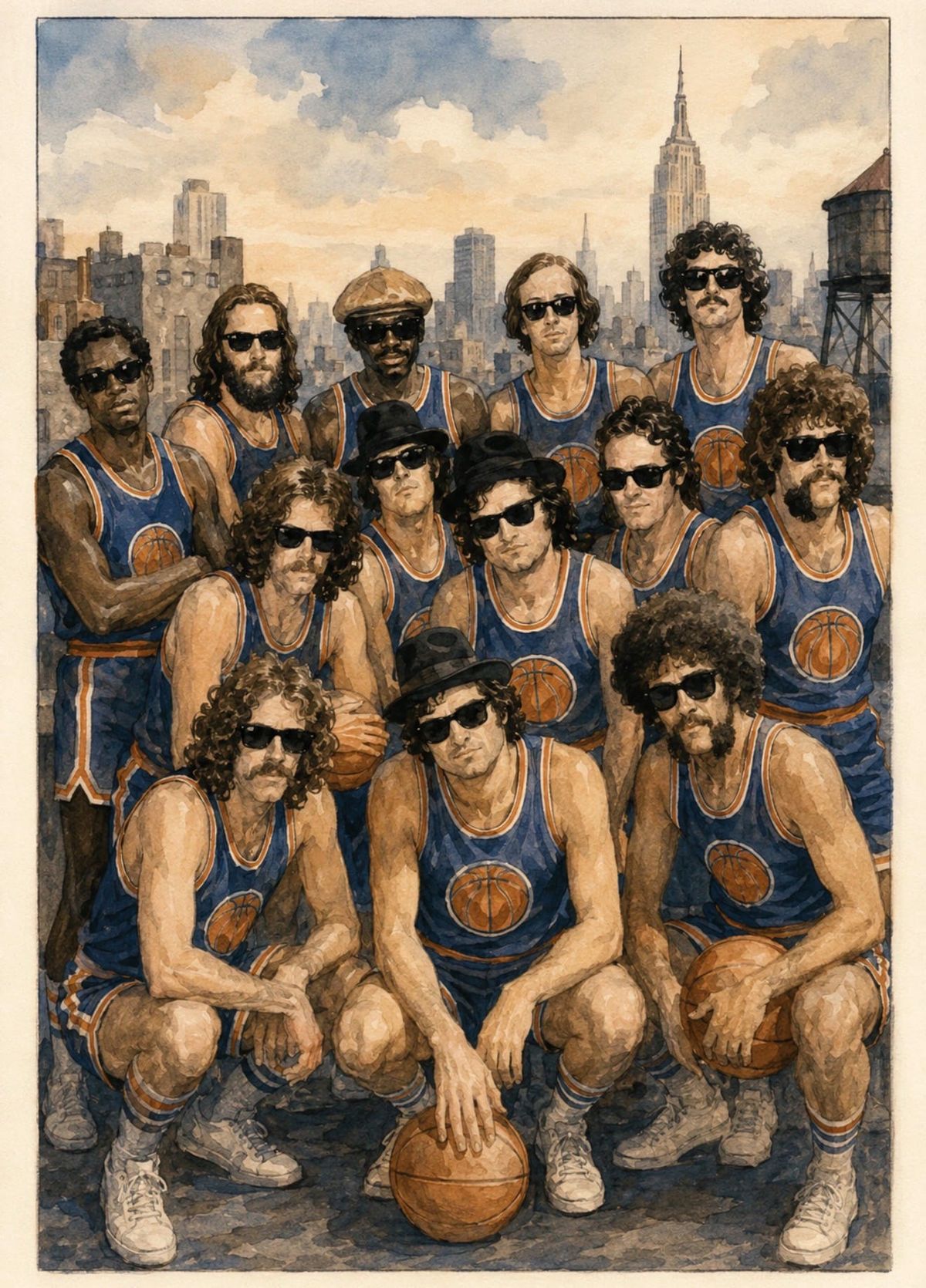
The Blues Brothers were on a mission from God to save a convent. The Nova Knicks, dressed not in black suits and sunglasses but in orange and blue, appeared to be on a mission to save something almost as endangered in modern America: the beautiful game of basketball.
Somewhere in the Catholic imagination, there is probably a division of labor for a night like this. St. Anthony gets called when something is lost. St. Jude gets called when the cause looks hopeless. By the time the Knicks were down 29 points in an NBA Finals game at Madison Square Garden, this one qualified on both counts. The game looked lost. The cause looked hopeless. And yet, for one strange, roaring night, the Nova Knicks played like a team sent to recover something that had gone missing from the game of basketball itself.
Then again, maybe there is something to be said for having a Nova man in the Vatican.
Somewhere through the carnage, Jake and Elwood Blues would have understood. After surviving gunfire, chaos, and the wildest car chase in cinema history, they reached the finish line because the mission mattered more than the wreckage. These Knicks, in their own roaring and ridiculous way, were trying to save something too.
Not the Celebrity Game
Not the celebrity game.
Not the one-man clear-out.
Not the slow, joyless, late-clock isolation possession where four players stand around like extras while one star pounds the ball into the floor, measures the defender, waves off the screen, and decides whether everyone else gets to participate.
I mean basketball.
The old game. The team game. The game of five men connected by one idea. Pass to the open man. Cut after you pass. Defend even when you are not scoring. Rebound when no one is watching. Sprint when the play appears to be over. Trust that the ball will find energy, and energy will find the ball.
For fifteen years, that game felt harder and harder to find in the NBA. The league became more talented than ever, more athletic than ever, more skilled than ever — and somehow, for many of us, less watchable. The sport that once moved like music too often turned into a celebrity showcase. One man dancing. Four men waiting. The crowd waiting. The possession waiting. The game itself waiting.
Anyone who has coached youth basketball over the last fifteen years will tell you the same infection has reached the grassroots game. Attend any of the thousands of AAU or travel games played around the country each summer and you will see it: point guards bringing the ball up the court and launching a three a few steps in from half court without a single pass; wings dribbling for what feels like an eternity while four teammates stand frozen; players driving one-on-three instead of making the easy dump-off pass for an open layup; kids looking almost allergic to defense; bigs and guards alike seeming afraid to make contact and actually box someone out. Too often, the game has become me-me-me basketball — an imitation of the worst habits of the professional game, copied by children before they have learned the best ones.
The Old Lesson
It was not always this way. The best teams of the old NBA were not anti-star; they were proof that the greatest stars become even greater when they play inside a shared concept. Larry Bird’s Celtics moved the ball through Bird, Kevin McHale, Robert Parish, Dennis Johnson, and Bill Walton with a hard-edged intelligence and an uncanny ability to find the open man. Magic Johnson’s Showtime Lakers were built around one of the most dazzling individual players who ever lived, but Magic’s genius was in making some of the most beautiful passes ever delivered and making everyone else faster, freer, and more dangerous. And even Michael Jordan’s Bulls, the team most associated with perhaps the single greatest player and scorer in history, became a dynasty only after Jordan accepted the triangle, trusted Scottie Pippen as a brilliant two-way wing, allowed Dennis Rodman to turn rebounding, defense, positioning, and sacrifice into their own form of stardom, and embraced the importance of role players like Steve Kerr, Toni Kukoc, Ron Harper, and Luc Longley. The old lesson was never that stars do not matter. The lesson was that stars matter most when they lift the whole five-man organism.
There was even a generational echo on the other bench: Dylan Harper, selected with the second pick of the 2025 NBA draft and one of the young Spurs trying to stop them, is the son of Ron Harper, the defensive-minded guard who helped Jordan’s Bulls turn sacrifice and role discipline into championship basketball.
Then Came These Knicks
Then came these Knicks.
Jalen Brunson, Josh Hart, Mikal Bridges, Karl-Anthony Towns, OG Anunoby — and the Villanova heartbeat running through the roster — have not merely won games. They have changed the argument. They have reminded New York, and maybe the whole league, that basketball is not supposed to be a solo act. It is supposed to be five players working in tandem, making the smart decision, and choosing the play that helps the team — not the one that fattens an individual stat line.
And last night, in the greatest basketball game I have ever seen, the Knicks did not just win Game 4 of the NBA Finals.
They made their case for the old game.
They were dead.
And some would say the game was dead too.
There is no softer way to say it. The Spurs were not beating them. The Spurs were burying them.
San Antonio came out shooting like a team blessed by every saint in the calendar. The ball left their hands and went in. Again. And again. And again. Victor Wembanyama loomed over the game like a science-fiction invention. De’Aaron Fox was attacking seams. Devin Vassell and the Spurs’ shooters were catching, rising, and splashing as if the rim had been widened. The spacing was clean, the rhythm was pure, and the scoreboard became almost absurd.
At halftime, the Spurs led 76–49. In the third quarter, they pushed the lead to 29.
Twenty-nine points.
In an NBA Finals game.
At Madison Square Garden.
Against a Knicks team that had been waiting half a century for a night like this.
The Hot Hand
There is an old basketball phrase for what San Antonio had: the hot hand. For decades, fans, players, coaches, and statisticians have argued over whether the hot hand is real or just the human mind seeing patterns in randomness. The classic 1985 study by Thomas Gilovich, Robert Vallone, and Amos Tversky argued that the hot hand was largely a cognitive illusion — that players and fans were seeing meaningful streaks where the numbers looked more like ordinary chance. But decades later, Joshua Miller and Adam Sanjurjo revisited the math and argued that the original analysis had missed a subtle selection bias: by looking only at shots that came after an already-identified streak, especially in short sequences, the method tended to understate the true chance of the next make. In other words, the famous “hot hand is a myth” conclusion may itself have been partly shaped by the way the streaks were selected.
Anyone who has played the game knows the truth lies somewhere between the numbers, a shooter’s form, and the discipline of taking thousands of shots in an empty gym.
Sometimes a shooter is not merely making shots.
Sometimes the ball seems magnetized to the rim, traveling along that beautiful arc before touching nothing but net.
That was San Antonio in the first half. It was not just good shooting. It was contagious shooting. One make became the next make. One clean pass became another open look. One open look became a roar, then a silence, then that sick feeling Knicks fans know too well — the sense that history has walked into the building wearing the other team’s jersey.
But the hot hand can also hide a weakness.
When everything is going in, you do not have to confront the hard parts of basketball. You do not have to grind. You do not have to execute late. You do not have to make the second read after the first read is gone. You do not have to win the ugly possession.
Sign up free for more independent reporting, morning briefings, and long-form storytelling from Short Stop Media — covering law, markets, New York, sports, public affairs, and the stories worth telling.
The Knicks Made It Ugly
The Knicks made the game ugly.
And that is where they began to win it.
This is the part that should be taught to every young player in America. The comeback did not begin with a miracle shot. It began with pressure. It began with bodies. It began with possessions where the Knicks defended without gambling, crashed without posing, and moved the ball without caring who got the credit.
Josh Hart is the perfect symbol of this team because he is the opposite of the modern box-score disease. In another basketball life, he could chase numbers. He could demand shots. He could complain on the nights when the offense does not run through him. Instead, he has become one of the great winning players in the sport because he understands that basketball has jobs most fans do not notice until they decide the game.
Some nights his job is to score.
Some nights it is to rebound like a power forward.
Some nights it is to hound the ball, cover for someone else, dive into the crowd, make the hit-ahead pass, and leave the floor looking like he just got into a bar fight under the old elevated tracks.
That is not glamorous basketball.
That is winning basketball.
Mikal Bridges brings another piece of the same gospel. He is length and patience and professional calm. He is a wing who knows that defense is not a highlight package. It is footwork. It is angles. It is denial. It is being in the right place one second before the casual viewer realizes that place matters.
Karl-Anthony Towns may be the most interesting case of all. For years, he was viewed by many as the prototype of the modern offensive star: talented, skilled, capable of huge numbers, but not always connected to winning in the way the great teams demand. On this Knicks team, he has become something more valuable. He has bought into a system where his talent is not diminished by sacrifice. It is sharpened by it.
That is the secret of great team basketball. The system does not make stars smaller. It makes them more dangerous because it gives their talent purpose.
And then there is Jalen Brunson.
Brunson is the engine. The adult in the room. The little-big man who plays with the old New York toughness, the Villanova precision, and the cold blood of someone who has spent his entire life being told he was not quite big enough, not quite fast enough, not quite whatever enough.
He does not float through games. He drags them into his possession.
The Bench Bought In Too
But the Knicks are not just a starting five. That is another reason this team feels so different. The bench has absorbed the same message. Jose Alvarado gave them perfect, fearless crunch-time points when the game could have slipped away. Mitchell Robinson gave them size, contact, vertical pressure, and the kind of physical presence that makes a young superstar feel every step. Miles McBride’s value has never been just whether he is hot from three; it is ball pressure, pace, and the willingness to guard ninety-four feet without needing applause. Precious Achiuwa, Landry Shamet, and the rest of the group know the deal. Some nights the bench gives you points. Some nights it gives you fouls, deflections, rebounds, minutes, and oxygen. On a team built on unselfishness, those are not small contributions. They are the bridge between survival and history.
The Villanova Architecture
The Villanova part of this story is not a gimmick. It is the architecture. Under Jay Wright, Villanova won national championships in 2016 and 2018 not because it collected the most famous one-and-done prospects in America, but because it built teams that understood spacing, toughness, shot selection, defensive accountability, and the sacred value of the extra pass. Villanova’s best teams could shoot, but they were never just shooting teams. They played with balance. They punished mistakes. They trusted guards to post, forwards to pass, wings to defend, and everyone to know time, score, and situation. Brunson, Hart, and Bridges did not bring nostalgia to the Knicks. They brought habits. They brought a way to play.
And last night, those habits met their perfect vessel in OG Anunoby.
The Quiet Force of OG Anunoby
Anunoby’s story has always had a quiet force to it. He was born in London, the son of Nigerian parents, and moved as a child to Jefferson City, Missouri, where his father taught at Lincoln University. He played at Jefferson City High School, grew into a serious prospect, and went on to Indiana University, where his combination of size, strength, defensive intelligence, and athletic restraint made him one of the more intriguing players in the country. Toronto selected him with the 23rd pick in the 2017 NBA Draft. With the Raptors, he became a champion, an elite defender, and eventually one of the league’s most coveted two-way wings. The Knicks acquired him in December 2023 in the trade that sent RJ Barrett and Immanuel Quickley to Toronto — a painful deal at the time for fans who loved those players, but the kind of cold, championship-minded move serious franchises eventually have to make.
Now, in New York, Anunoby has become the perfect Knick for this moment.
Not loud.
Not theatrical.
Not desperate to be the face of anything.
Just serious. Strong. Efficient. Dangerous. The kind of player who can score 33 points, make seven threes, guard the other team’s best option, and still have the most important thing he does come on a play that began with defense and ended with a second effort.
The Final Possession
Which brings us to the final possession.
Brunson scored 36 points last night, and he had every right to believe the final shot belonged to him. In the modern NBA, that is usually where the story ends. Star gets ball. Star isolates. Star takes the shot. Everyone else watches. The postgame show debates whether the shot was heroic or selfish.
But the reason this Knicks team is different is that even when the ball stops, the players do not.
The final play will live forever because of the tip-in. That is the image: the ball coming off the rim, Anunoby rising, the Garden detonating, the Knicks suddenly ahead 107–106 with 1.2 seconds left, half a century of ghosts shaking loose from the rafters.
But the real beauty of the play began before the shot.
It began on defense.
The Spurs had the ball and the lead. De’Aaron Fox attacked the rim. Anunoby did not watch. He did not concede. He did not hope someone else would rotate. He pursued the play and blocked it.
That was the first act.
Then came the inbound.
Anunoby took the ball out of bounds. This detail matters. Most people will remember him only as the man who finished the play, but he began it as the man who restarted it. He inbounded to Brunson, then returned to the floor.
Brunson had the ball. The Spurs sent help. Two defenders were drawn toward him because that is what Brunson does. He bends the court. He forces panic. He creates a choice: stay home and let him cook, or attack him and trust the back line to survive.
For one flash, Anunoby was open.
Brunson probably should have hit him. That is not criticism. That is the X-and-O truth of the moment. OG had space. The right pass was there. The pass did not come.
In the selfish version of basketball, the play ends there for everyone but Brunson. The open man does not get the ball, so he stops. He watches. He prepares to blame the star or the coach or fate.
OG Anunoby did not stop.
That is why the play is emblematic of this Knicks team.
He had already done his job. Then he did the next job. He inbounded. He got open. He did not receive the pass. He kept moving. He streaked toward the rim. He avoided being boxed out. He followed the miss not as a desperate afterthought but as a principle.
The shot went up.
OG went in.
That is basketball.
Not celebrity basketball. Not isolation basketball. Not “my turn, your turn” basketball. Basketball.
The Knicks won because Anunoby understood something that the best teams understand and the worst habits of modern basketball often forget: the play is not over when you are not the one shooting. The play is alive until the ball is secured, the whistle blows, or the scoreboard changes.
On that possession, the scoreboard changed.
And maybe the league did too.
Keep Going
There is a reason this Knicks team feels different. It is not just because Brunson, Hart, and Bridges carry the Villanova connection. That matters, of course. But the “Nova Knicks” idea is larger than a college reunion.
It is a style of life on a basketball court.
It is the belief that the game rewards the player who does the right thing even when the crowd misses it. It is Brunson taking punishment and still organizing the floor. Hart rebounding in traffic against bigger bodies. Bridges running lanes and defending without complaint. Towns accepting that greatness can mean making the next pass. Robinson setting a screen that frees someone else. Alvarado giving them points and pressure off the bench. McBride hounding the ball. Anunoby giving you 33 points, seven threes, a game-saving block, and still being remembered most for a play that required the simplest command in the sport:
Keep going.
That is why last night was not merely a comeback.
It was a rebuttal.
Sign up free for more independent reporting, morning briefings, and long-form storytelling from Short Stop Media — covering law, markets, New York, sports, public affairs, and the stories worth telling.
The Beautiful Game
For years, the American game has drifted toward the cult of the individual. The European game, by contrast, has often been praised for its fundamentals: spacing, passing, shooting, off-ball cutting, team defense, and the understanding that five connected players can be more dangerous than one spectacular player.
That contrast can be overstated. America has produced beautiful team basketball. Europe has produced stars with every bit as much individual genius. The truth is not geography. The truth is philosophy.
Last night, the Knicks chose the philosophy of the beautiful game.
San Antonio had the hot hand. The Knicks had the longer memory.
They remembered that shooting streaks come and go. Ball movement survives. Defense travels. Rebounding tells the truth. The extra pass still matters. The weak-side cut still matters. The box-out still matters. The second effort still matters. The man who does not get the pass still matters.
That is why whoever won last night was going to win this series.
Had the Spurs survived, the Finals would have been tied 2–2, and San Antonio would have walked away knowing it could absorb Madison Square Garden, absorb Brunson, absorb the noise, and reclaim control. The Knicks would have carried the weight of the blown chance all the way back to Texas.
Instead, the Knicks took a 3–1 lead.
And no matter how careful everyone will be in public, everyone in basketball knows what that means. The Finals did not mathematically end last night. But spiritually, historically, emotionally, it turned. The Knicks were left for dead, came back from the largest deficit ever erased in an NBA Finals game, and did it not by becoming frantic but by becoming more themselves.
That is the part that makes this one of the great games ever played.
Maybe the greatest, if you love basketball for the right reasons.
Not because it was perfect. It was not. The Knicks were awful for long stretches. They were late to shooters. They were buried in the first half. Brunson missed the final shot. The pass to OG was there and did not come.
But perfection is not why we watch.
We watch because a team can be down 29 and still find itself. We watch because a shooter can look touched by heaven for two quarters and then feel the floor tilt. We watch because a player can make the wrong read and still be saved by a teammate making the right effort. We watch because a game can appear lost, then become a sermon.
The Sermon
The sermon last night was simple.
Pass the ball.
Guard your man.
Help the helper.
Crash the glass.
Run after you pass.
Do your job.
Then do the next job.
That is what OG Anunoby did. He did not make the play because he was lucky. He made the play because he never stopped playing. He made the play because the Knicks, at their best, have become a team of men who understand that the game does not belong to the loudest star, or the hottest shooter, or the biggest name.
It belongs to the five players most willing to stay connected when everything is falling apart.
The Knicks were on a mission last night.
Maybe not from God.
But close enough for Madison Square Garden.
If you enjoyed this article, please consider supporting our work and making a simple one-time donation by clicking below and by subscribing as a Member to our site.


Comments ()