The Oldest Duty: Fatherhood and the Making of Civilization
From Troy to the Twin Towers, Fathers have always stood between their Families and the Dark
Sign up free for more independent reporting, morning briefings, and long-form storytelling from Short Stop Media — covering law, markets, New York, sports, public affairs, and the stories worth telling.
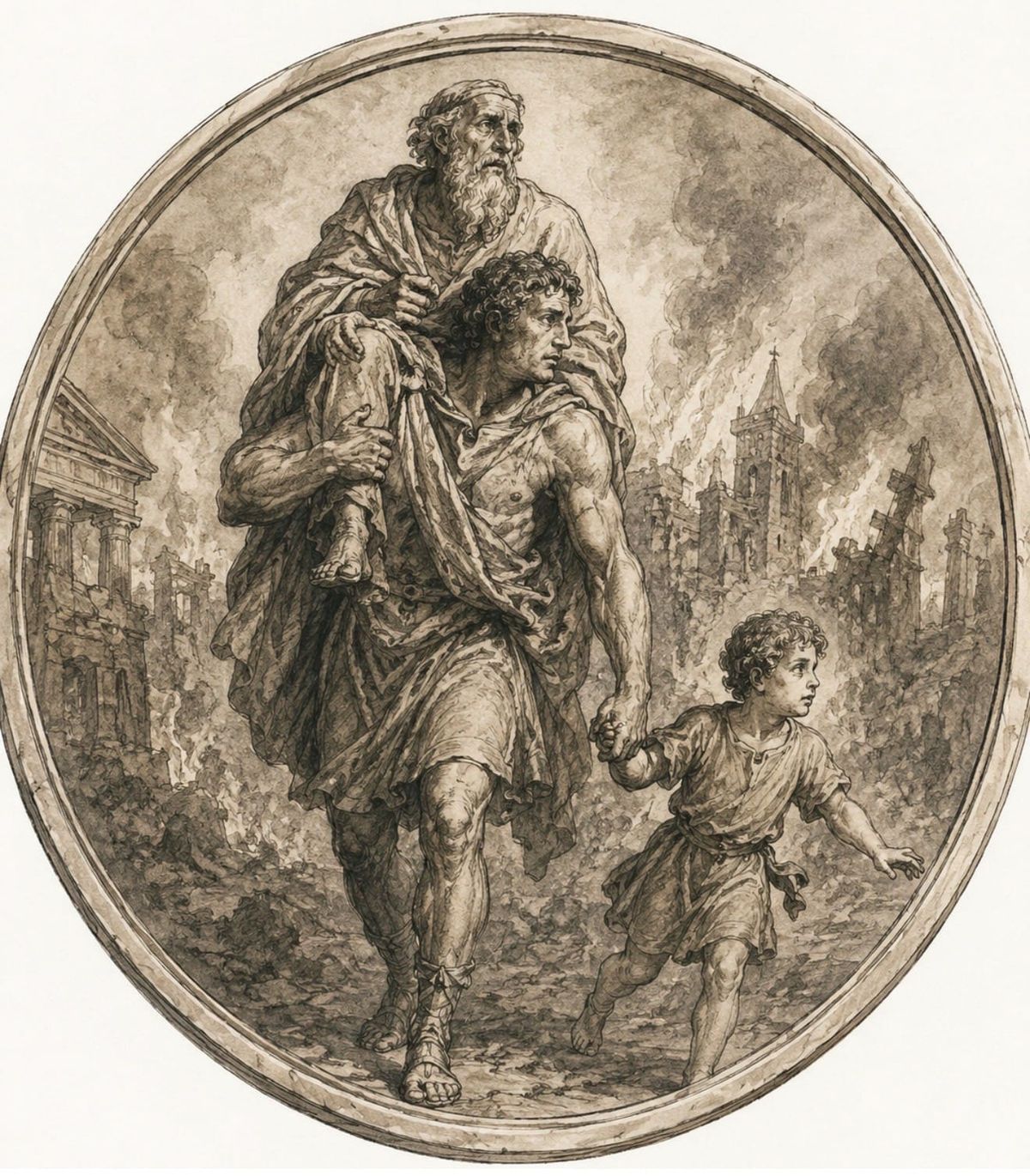
As the city of Troy burned around him, Aeneas faced a terrible choice.
The Greeks had breached the walls. Fires spread through the streets. Death was everywhere. Escape would be difficult enough for one man. Yet Aeneas refused to abandon his family.
In one of the most famous images in all of classical literature, Aeneas placed his elderly father Anchises upon his shoulders while taking his young son Ascanius by the hand. Together they fled the collapsing city. Three generations moved through smoke and fire and chaos while enemies closed in around them.
Roman writers later treated this moment as the embodiment of duty itself. Aeneas protects both the generation that came before him and the generation that follows. His father represents memory and tradition. His son represents the future. Standing between them, Aeneas becomes the bridge connecting past and future — the living link upon which everything depends.
The image wasn’t merely literary. Roman soldiers carried it in their pockets — coins minted under Julius Caesar and Augustus bore the scene of Aeneas and Anchises — and Augustus placed a statue of the same three generations at the center of his Forum, the ceremonial heart of Roman military life. To the legions, Aeneas wasn’t just a founding ancestor. He was the living definition of pietas: the supreme Roman virtue of duty to gods, family, and the state for which a soldier fought and, if necessary, died.
More than two thousand years later, that image endures as one of history’s most powerful symbols of fatherhood.
Long derided by some as little more than a “Hallmark holiday” designed to boost sales for greeting card companies and the nation’s retailers, Father’s Day actually celebrates something far older and more important than consumerism.
The recognition of a father’s role in creating, sustaining, and defending the family — the fundamental building block of every civilization — is a tradition that stretches back to the dawn of recorded history. From the city-states of ancient Greece and the legions of Rome to the Celtic clans of Ireland and Scotland, the Germanic tribes of northern Europe, and ultimately the American Republic, societies have consistently recognized the importance of fathers as providers, protectors, teachers, and custodians of the next generation.
So on this warm June Sunday, as millions of fathers across America unwrap ill-fitting polo shirts (thankfully neckties have largely been relegated to the dust heap of bad-gift history), backyard gadgets, and assorted tchotchkes before firing up the grill, answering calls from grown children, watching the U.S. Open, the World Cup, a baseball game, or simply enjoying a few quiet hours with family, it may be worth pausing for a moment.
Because behind the crowded restaurant dinners, the gifted bottles of bourbon and wine, and all the other familiar rituals lies a truth far older than Father’s Day itself.
For thousands of years, fathers have stood between their families and hunger, danger, uncertainty, and despair. They have hunted, farmed, sailed, built, fought, taught, sacrificed, and passed on hard-earned knowledge to those who would follow them. Entire civilizations have risen and endured because one generation prepared the next to inherit the world.
To understand fatherhood is to understand one of the oldest and most universal responsibilities in human history.
The First Promise
Before fathers taught values, they had to solve a more immediate problem.
How do you keep your children alive until tomorrow?
For most of human history, fatherhood was inseparable from survival. Among hunter-gatherers, fathers hunted. Among early farmers, fathers planted and harvested. Along rivers they fished. On grasslands they tended herds. Before there were salaries, pensions, stock portfolios, or supermarkets, every meal — and survival itself — represented a sacrifice of labor.
The first promise every father made was simple:
I will find food.
That promise appears in almost every civilization.
Among the indigenous peoples of North America, fathers taught children how to hunt, fish, track animals, and survive in environments that could be both beautiful and unforgiving. Knowledge was not a hobby. Knowledge was survival.
Among the Celts of Ireland, Scotland, and Wales, fathers taught sons and daughters how to tend livestock, manage land, navigate clan loyalties, and defend their communities. Wealth was measured in cattle, property, reputation, and kinship. A father did not merely provide food. He preserved the family’s place in the world.
The warrior cultures that challenged Rome carried similar expectations. Germanic tribes taught hunting, farming, and warfare. Fathers among the Goths, Franks, and Saxons prepared children for lives in difficult frontier environments. Further east, on the vast Eurasian steppes, nomadic fathers introduced children to horses almost as soon as they could walk. Horsemanship was not recreation. It was survival.
Even Sparta, perhaps history’s most famous warrior society, understood that military excellence began long before a boy entered formal training. Discipline, courage, and duty were first learned within the household.
A father unable to provide could not fulfill any of his other responsibilities.
Food came first.
Everything else followed.
The Ancient Stories
The importance of fathers became so deeply embedded in human experience that it found its way into the oldest stories civilization told about itself.
When the Trojan War ended, Odysseus should have returned home immediately. Instead, according to Homer, his voyage lasted another ten years. During his absence, his infant son Telemachus grew into manhood without truly knowing his father. Meanwhile, dozens of powerful men occupied Odysseus’s household, consumed his wealth, and pressured his wife Penelope to choose a new husband.
As Telemachus matured, he became increasingly desperate to discover the truth about the father he barely remembered. His search for Odysseus becomes one of the central emotional threads of The Odyssey. While the poem is famous for monsters, storms, and adventures, its deeper story concerns a son seeking the father whose example has shaped his identity despite years of absence.
When Odysseus finally returns — disguised and unrecognized — father and son are reunited. Together they confront the armed suitors who threaten their family and home. In one of literature’s earliest and most enduring father-son moments, they stand side by side against overwhelming odds.
The scene resonates across centuries because it captures a universal longing: the desire of a father to protect his family, and the desire of a son to stand beside him.
📬 If you enjoy thoughtful long-form journalism, historical perspective, legal analysis, business insights, and stories that connect today’s headlines to the larger forces shaping our world, consider subscribing to Short Stop Media.
Subscriptions are free and help support independent reporting, original research, and in-depth storytelling you won’t find in a typical news feed.
The Sacred Inheritance
Perhaps no father-son story has influenced Western civilization more deeply than the story of Abraham and Isaac.
According to the Hebrew Bible, Abraham was commanded by God to sacrifice his beloved son. The story reaches its climax when Abraham, prepared to obey, is stopped at the last moment. For thousands of years, theologians, philosophers, and ordinary parents have wrestled with its meaning.
At its core lies one of humanity’s deepest questions: what would a father sacrifice, endure, or surrender for something greater than himself?
Whether viewed as history, theology, or literature, the story remains one of the most emotionally powerful explorations of fatherhood ever written.
Christianity would carry the idea even further.
At the center of the Christian faith stands the story of a Father willing to sacrifice His only Son for the redemption of humanity. The symbolism is impossible to miss. The highest form of fatherhood becomes sacrifice. The ideal father is no longer merely a ruler, provider, or authority figure. He becomes a servant. A steward. Someone willing to place the needs of others before his own.
This represented a dramatic departure from many ancient concepts of power.
Authority remained important.
But sacrifice became essential.
The influence of that idea would shape Europe for nearly two thousand years.
The Great Transfer
As civilizations grew more sophisticated, fatherhood evolved.
The question was no longer merely how to feed a child tomorrow. The question became how to prepare that child to thrive after the father was gone.
Throughout medieval Europe, fathers passed down more than property. They passed down livelihoods.
A blacksmith taught metalworking. A carpenter taught woodworking. A mason taught stonecraft. A farmer taught agriculture. A cooper taught barrel-making.
For centuries, entire trades survived because fathers trained the next generation. The inheritance was not merely economic. It was cultural. Each profession carried techniques, standards, stories, reputations, and values accumulated across generations.
Fathers became living libraries.
The challenge had changed.
No longer: How do I feed my children?
Now: How do I teach them to feed themselves?
The answer remained remarkably consistent.
Teach them what you know.
What the West Inherited
By the time the settlers who would eventually build America crossed the Atlantic, they carried an inheritance assembled over centuries.
They inherited clan loyalty from Celtic ancestors. Duty and independence from Germanic traditions. Citizenship from Rome. Sacrifice and stewardship from Christianity. Their ancestors came from Ireland, Scotland, England, Wales, Germany, France, the Netherlands, and Scandinavia. Their customs differed. Their accents differed. Their politics differed.
Yet most shared a common understanding of fatherhood.
A father was expected to provide.
A father was expected to protect.
A father was expected to teach.
The Founding Fathers rarely described these ideas as political theory. They assumed them. A free republic depended upon responsible citizens. Responsible citizens were formed first within families. Before a child became a voter, soldier, merchant, craftsman, farmer, lawyer, or statesman, he or she was first a son or daughter.
The family was the first school of citizenship.
And fathers stood among its most important teachers.
One Question, Every Civilization
Yet the story does not belong exclusively to the West.
Jewish fathers emphasized learning and scripture. Islamic fathers emphasized stewardship, justice, and moral leadership. Confucian fathers in China taught duty, respect, and social harmony. Japanese fathers emphasized discipline, sacrifice, and obligation. Indian fathers often served as guardians of both family and spiritual tradition. Across Africa, fatherhood frequently extended beyond the individual household to include uncles, elders, and entire communities invested in raising children.
The customs differed.
The religions differed.
The languages differed.
Yet the central challenge remained remarkably similar.
How do we prepare those who come after us?
Every civilization eventually arrived at the same conclusion: children inherit more than genes. They inherit stories. Skills. Values. Faith. Identity. Responsibility. Hope. Every generation receives a world it did not build. Every generation must prepare someone else to inherit it.
That responsibility connected a Celtic clansman in ancient Ireland to a Roman citizen, a Jewish scholar, a Confucian father in China, a village elder in Africa, and a frontier farmer in colonial America.
The tools changed.
The mission did not.
📬 If you enjoy thoughtful long-form journalism, historical perspective, legal analysis, business insights, and stories that connect today’s headlines to the larger forces shaping our world, consider subscribing to Short Stop Media.
Subscriptions are free and help support independent reporting, original research, and in-depth storytelling you won’t find in a typical news feed.
The Birth of Father’s Day in America
The modern Father’s Day holiday in America is generally credited to Sonora Smart Dodd of Spokane, Washington.
In 1909, while listening to a Mother’s Day sermon, Dodd began thinking about her own father, William Jackson Smart. Her mother had died while giving birth to her sixth child. Rather than remarry or place the children elsewhere, William Smart raised all six children himself on a farm in eastern Washington.
Dodd believed fathers deserved recognition too.
She proposed a day honoring fathers much like Mother’s Day honored mothers. She originally wanted the celebration held on June 5 — her father’s birthday. Local churches and organizers needed more time to prepare, however, so the event was moved to the third Sunday in June. The first recognized Father’s Day celebration took place in Spokane on June 19, 1910.
That scheduling decision — essentially a practical compromise — ultimately became the permanent date.
So Father’s Day falls in June not because of any ancient tradition, agricultural calendar, religious feast, or historical event.
It falls in June because that was the birth month of one devoted father in Washington State.
Several presidents supported the idea. Woodrow Wilson and Calvin Coolidge both backed formal recognition, but Congress repeatedly hesitated. Finally, in 1966, Lyndon B. Johnson issued a presidential proclamation recognizing Father’s Day. In 1972, Richard Nixon signed legislation making it a permanent national holiday.
That means Father’s Day became an official U.S. holiday nearly sixty years after Mother’s Day, and almost two hundred years after the founding of the republic.
When It Counts Most
Which brings us to the present.
During the attacks of September 11, hundreds of fathers trapped inside the World Trade Center used their final moments not to focus on themselves but on their families. Phone records and voicemail messages reveal a recurring pattern. Men called wives to say goodbye. They reassured frightened children. They expressed love, offered guidance, and tried to provide comfort despite knowing they might not survive. In many cases their final acts were those of fathers rather than employees, executives, firefighters, or office workers.
Even in catastrophe, their instinct was to protect the people they loved.
When the Indian Ocean tsunami struck in December 2004, waves reaching heights of over a hundred feet devastated communities across multiple countries. Survivors later recounted story after story of fathers physically lifting children above the water, pushing them toward rooftops, trees, or rescue boats — and in some cases sacrificing themselves to improve their children’s chances of survival. What stands out is not any individual story, but how frequently the same instinct appeared across different cultures and nations.
Faced with overwhelming force, fathers repeatedly chose their children’s lives over their own.
Aeneas, carrying his father through the flames of Troy. Odysseus, fighting his way home to a son who barely remembered him. Thousands of fathers in lower Manhattan and along the coast of the Indian Ocean — moved by the same instinct that has driven men since the first family huddled against the dark.
Two thousand years of history.
The same response.
Why It Still Matters
For one day each year, fathers become the subject.
Behind the cookouts, the cards, the clothes, the gifted tools, knick-knacks, framed pictures, and bottles of bourbon, scotch, or wine, and all the familiar rituals lies a truth that stretches across thousands of years and every civilization humanity has ever built.
Fathers have always stood between their families and whatever threatened them. They have always tried to pass on more than they received. They have always asked, in one form or another, the same question that Aeneas was answering when he lifted his father onto his shoulders and took his son by the hand as Troy burned.
How do I make sure my children survive?
Civilizations endure because parents teach children how to carry the story forward.
And fathers, for all their imperfections — the ill-fitting polo shirts, the forgotten anniversaries, the fumbled advice — have long been among the principal custodians of that inheritance.
If you enjoyed this article, please consider supporting our work and making a simple one-time donation by clicking below and by subscribing as a Member to our site.
📬 If you enjoy thoughtful long-form journalism, historical perspective, legal analysis, business insights, and stories that connect today’s headlines to the larger forces shaping our world, consider subscribing to Short Stop Media.
Subscriptions are free and help support independent reporting, original research, and in-depth storytelling you won’t find in a typical news feed.

Comments ()