The Life, Death and Legacy of NYPD Detective First Grade Jonathan Diller
After the Sentence: A Family, a Department, and a City Forever Changed
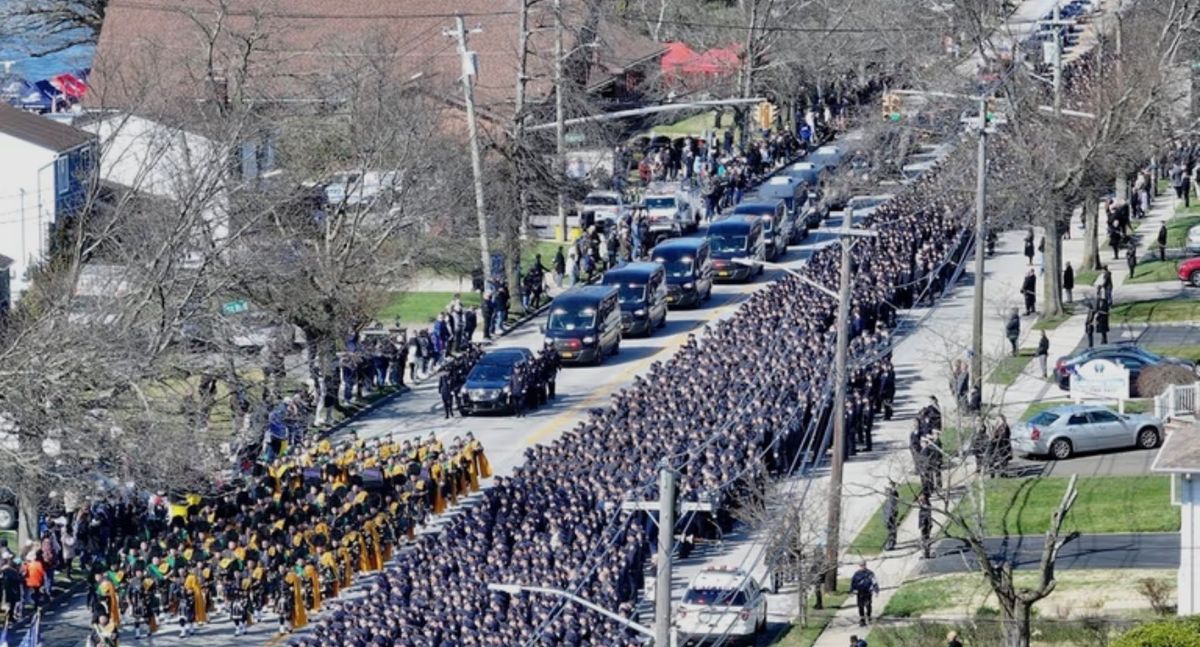
Photo Source: Newsday
Now that the sentence has been handed down, the case of Jonathan Diller has reached its legal conclusion.
What remains is everything the law cannot resolve: a young family altered forever, a police department still carrying the loss, and a moment of violence that continues to echo far beyond the street where it began.
On April 27, 2026, the man responsible for Diller’s death was sentenced to 115 years to life in prison, a punishment that ensures he will spend the rest of his life behind bars.
It is the system’s final word.
It is not an ending.
A Late Afternoon in Far Rockaway
At approximately 5:50 p.m. on March 25, 2024, Detective Jonathan Diller approached a vehicle illegally parked at a bus stop on Mott Avenue in Far Rockaway, Queens.
Diller, 31, was assigned to the Queens North Community Response Team, a unit tasked with addressing quality-of-life and crime conditions in neighborhoods across northern Queens.
The encounter lasted seconds.
A passenger inside the vehicle produced a firearm and opened fire. Diller was struck in the torso, below his protective vest. Another officer returned fire, wounding the gunman.
Diller was transported to Jamaica Hospital Medical Center.
He did not survive.
The suddenness of the shooting—how quickly a routine stop became fatal—shocked even veteran officers. It was the kind of call that begins as ordinary and ends as something irreversible.
The Man Behind the Badge
Jonathan Diller was raised in Franklin Square on Long Island, the youngest of three children in a close-knit family.
At St. Mary’s High School in Manhasset, he was a multi-sport athlete, playing lacrosse, hockey, and enjoyed skiing. He was a key part of a state championship lacrosse team—and teammates and coaches would later recall his discipline and quiet competitiveness. These were traits that carried into his adult life.
He graduated from SUNY Maritime College, tucked beneath the Throgs Neck Bridge—one of the crossings connecting Long Island to the mainland—and began a career in the shipping industry before ultimately choosing law enforcement.
He joined the New York Police Department in 2021.
Colleagues described him as steady, reliable, and committed—an officer who did the job without seeking attention, but who could be counted on in difficult moments.
At home, he was a husband and a father.
He married Stephanie in 2019. She worked as an emergency room nurse. Together, they built a life grounded in service—two professions defined by showing up when others are in need.
Their son, Ryan, had just turned one.
That was the life interrupted.
A Community Absorbs the Loss
Diller lived in Massapequa Park, a South Shore Long Island community where ties between families run deep and often span generations.
In places like Massapequa, tragedy does not remain contained.
It moves.
Neighbors gathered quickly—on sidewalks, in driveways, outside homes. Blue ribbons appeared across the community. Candlelight vigils formed. Local businesses displayed tributes. Police officers and firefighters stood alongside residents in quiet solidarity.
The loss was not distant. It was personal.
Support followed. The Tunnel to Towers Foundation paid off the mortgage on the Diller family home, ensuring that his wife and son could remain there. Donations and assistance came from across the country.
The gestures provided stability.
They did not change the reality.
The Wake
At the Massapequa Funeral Home, mourners lined up in steady succession.
Uniformed officers stood alongside elected officials, neighbors, and strangers who felt compelled to come. Among them was President Trump, whose visit drew national attention.
Inside, the scale of the story narrowed again.
A casket. A young widow. A child too young to understand what had been lost.
The Funeral at St. Rose of Lima
On March 30, 2024, the funeral was held at St. Rose of Lima Roman Catholic Church in Massapequa.
The surrounding streets—Merrick Road and nearby routes—were closed as thousands of officers gathered in formation. Helicopters hovered overhead. Bagpipes carried through the neighborhood. The visual was unmistakable: a sea of uniforms stretching far beyond the church doors.
Inside, Police Commissioner Edward Caban delivered one of the day’s most significant announcements.
Jonathan Diller, who had been serving as a detective at the time of his death, would be posthumously promoted to Detective First Grade.
With that promotion came a new shield number: 110, chosen to honor the birthday of his one-year-old son.
The promotion was both symbolic and formal—a recognition of service and sacrifice that would permanently attach to his name.
Outside, the department stood in silence.
Inside, a family said goodbye.
If you find yourself drawn to stories like this—about people, memory, and the moments that stay with us—please follow and share this article. It helps us continue telling them the right way.
The Trial
The case proceeded through the courts over the following two years.
Prosecutors argued that the defendant deliberately fired at Diller during the traffic stop. The defense contended the gun discharged during a struggle.
The trial reconstructed the final moments—through testimony, forensic evidence, and cross-examination.
For Diller’s family and fellow officers, it was not simply a legal process.
It was a return to the worst day of their lives.
The jury ultimately convicted the defendant on multiple serious charges, though not on the top count of murder—a distinction that carried significant dismay and emotional weight for those closest to the case.
The Sentence
At sentencing, the court imposed a punishment totaling 115 years to life in prison, ensuring that the defendant will spend the remainder of his life behind bars.
It is, in legal terms, a resolution.
But outside the courtroom, its meaning is more limited.
No sentence restores what was lost—the ordinary future of a young family, the daily presence of a father, the life that was still unfolding.
Justice can impose consequence.
It cannot restore.
The Final Inspection
Police funerals are defined by ritual: the folded flag, the final radio call, the slow salute, the sound of bagpipes fading into silence.
Among those traditions is a poem often associated with law enforcement memorials, known as “The Final Inspection,” imagining an officer standing before God after his last tour of duty.
“The policeman stood and faced his God,
Which must always come to pass.”
For Jonathan Diller, that final inspection came far too soon.
He left home that March afternoon as a detective, a husband, and a father.
He did not return.
And now, with the sentence delivered, what remains is not closure, but memory—of the man he was, the family he loved, and the moment that changed everything.
In the years ahead, his name will not be remembered for how his life ended, but for how it was lived—and who still carries it forward.



Comments ()