The Founders: The People Who Built SpaceX
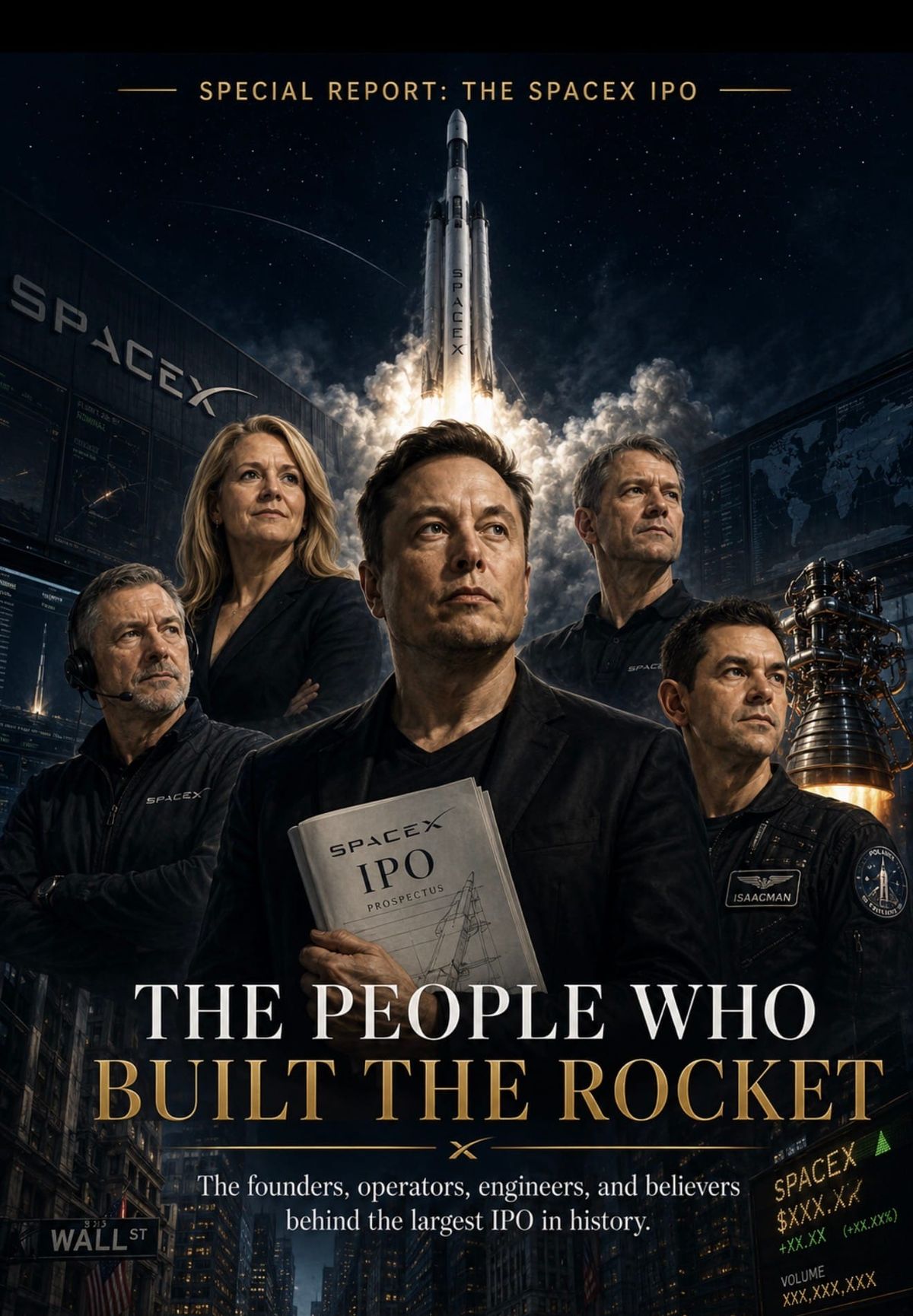
PART 2 OF 3
SPECIAL REPORT: THE SPACEX IPO
One man with an improbable dream. A handful of engineers, executives, and investors who believed him. This is the story of the people who turned "making life multiplanetary" into the largest IPO in history.
Part One: Before the Company
The Boy Who Read His Way to the Stars
The story of SpaceX begins in a row house in Pretoria, South Africa, in 1971, with a boy named Elon Reeve Musk who could not stop reading. By the age of nine he had worked his way through the Encyclopedia Britannica and the Encyclopaedia Africana, both in their entirety. When those ran out, he moved through science fiction — Isaac Asimov's Foundation series gave him the framework he would carry into adulthood: that the long-term survival of humanity depends on its ability to expand beyond a single world. By the time he was twelve, he had taught himself to code, written a video game called Blastar, and sold it to a PC magazine for $500.
Musk's childhood was not comfortable. His parents, Errol and Maye Musk, divorced when he was nine. He has described being bullied severely throughout his school years in South Africa, to the point of being thrown down a flight of stairs. He is believed to have Asperger's syndrome — a diagnosis he confirmed in a 2021 appearance on Saturday Night Live — and he has described his childhood brain as running constant, involuntary algorithms, modeling systems, stress-testing assumptions, calculating failure modes. What looked from the outside like a quiet, bookish child was, on the inside, building a mental simulation of how the world works — a model he would spend the rest of his life stress-testing against reality.
He immigrated to Canada at 17, using his Canadian mother's passport as a route to North America, then transferred to the University of Pennsylvania, where he earned undergraduate degrees in economics and physics and developed the intellectual tools he would later use to argue that conventional aerospace was overpriced by a factor of five to ten. He enrolled in a PhD program in applied physics at Stanford in 1995, intended to study energy storage and ultracapacitors, and lasted two days. The internet was exploding. Musk dropped out.
What followed is now well-documented: Zip2 (city guides for newspapers), sold to Compaq in 1999 for $307 million; X.com (internet banking), which merged with Confinity to become PayPal, then sold to eBay in 2002 for $1.5 billion. Musk's after-tax take from those two exits was approximately $180 million — and with essentially all of it, he made two bets. One was Tesla, which he co-founded and funded. The other, in June 2002, was SpaceX. He put roughly $100 million into the new rocket company and gave himself, in his mind, a 10 percent chance of success. He has described the decision not as optimism but as a calculated decision to act rather than regret.
The Founding: Six Months in a Borrowed Office
SpaceX was incorporated on May 6, 2002, in Delaware, with principal operations launched from a warehouse in El Segundo, California. Musk's ambition was explicit from day one: "Making life multiplanetary — starting with Mars." He recruited a small founding team of aerospace engineers, many of them from TRW, Boeing, Orbital Sciences, and the Jet Propulsion Laboratory, and set them to work on an impossible mandate: build a rocket that could reach orbit for a fraction of what the government was paying.
The first rocket, the Falcon 1, failed three times. The first flight, in 2006, tumbled into the Pacific 30 seconds after liftoff. The second, in 2007, made it to 289 seconds before a fuel slosh sent it into an uncontrolled roll. The third, in August 2008, failed to stage correctly and never reached orbit. By September 2008, Tesla was on the verge of bankruptcy and SpaceX was days from running out of money. On September 28, 2008, the fourth Falcon 1 launched from Omelek Island in the Pacific. It reached orbit. Musk has said he broke into tears. He had hours of money left.
In December 2008, NASA awarded SpaceX the Commercial Resupply Services contract, its first major government customer. In 2010, Falcon 9 flew for the first time. In 2012, Dragon became the first commercial spacecraft to dock with the International Space Station. What followed over the next fourteen years — reusable boosters, human spaceflight, Starlink, COLOSSUS, the xAI merger — is what is now being offered to the public at $1.75 trillion. None of it would have existed without the people who agreed to take Musk's bet.
Part Two: The Key People
Elon Musk — Founder, Chief Executive Officer, and Controlling Shareholder
Today Musk is 54 years old, still leads SpaceX as chief executive, and remains the company's dominant executive, shareholder, and creative force. He holds approximately 42 percent of the economic equity in SpaceX, and through his Class B shares, is expected to control more than 82 percent of all voting power following the IPO. His compensation package — 1 billion newly granted restricted Class B shares on top of his existing position — could be worth an additional $135 billion at the IPO price and is tied to milestones including establishing a million-person colony on Mars.
As SpaceX heads into its IPO, Musk simultaneously runs Tesla (where he is CEO and owns approximately 13 percent), xAI (the AI company now folded into SpaceX), X (the social media platform), Neuralink (brain-computer interfaces), and the Boring Company (tunnel infrastructure). Each company has produced real products and some have reached profitability or significant scale. Each also demands real management attention, and the S-1 explicitly names Musk's divided attention as a material risk factor. His defenders argue that no one has ever built more transformative companies simultaneously. His critics argue that no public company should trade at a premium to any peer while its leader is simultaneously the most controversial businessman on the planet, a recent government employee, and the subject of ongoing conflict-of-interest investigations.
Both things are true. Musk is the reason SpaceX exists, the reason it is worth anything, and the reason many investors have reservations. The S-1 says it plainly: the company's success depends substantially on his continued involvement. He has no plans to leave.
"Musk is the reason SpaceX exists, the reason it is worth anything, and the reason many investors have reservations. Both things are true."
Gwynne Shotwell — President and Chief Operating Officer
If Musk is SpaceX's soul, Gwynne Shotwell is its spine. As President and Chief Operating Officer, Shotwell is responsible for the daily operations of a company that in 2025 generated $18.7 billion in revenue across three distinct business segments spanning 13 time zones. She has been described by people who work at the company as the reason there is a company to work at — the operational counterweight to Musk's visionary intensity, the person who makes the launches actually happen, the deliveries ship on schedule, the government contracts close. She joined SpaceX in 2002, when the company had fewer than twenty employees, as Vice President of Business Development, and has served as President since 2008.
Shotwell grew up in the suburbs of Chicago, attended Northwestern University on a scholarship to study mechanical engineering, and took her first job at the Aerospace Corporation, a federally funded research center in El Segundo, California. When she met Musk at an industry conference, SpaceX was six months old. She was Employee No. 11. Her first job was to bring in revenue for a company that had never launched anything. She signed the original contract with NASA for COTS resupply and has managed the company's government relationships — with NASA, the Department of Defense, and more recently DOGE-adjacent entities — ever since.
Shotwell holds significant SpaceX equity, though the company has not disclosed exact figures for any executive other than Musk. She was awarded a 2024 Heinlein Award for contributions to commercial space. She is one of the most important executives in the American aerospace industry and has stated publicly that she intends to see SpaceX through its first mission to Mars. She does not plan to leave either.
Tom Mueller — Founding Propulsion Engineer
If there is one person responsible for the fact that SpaceX's rockets work, it is Tom Mueller. Born in Twin Falls, Idaho, Mueller began building model rockets as a teenager and eventually rose to become the lead propulsion engineer at TRW in Los Angeles, where he worked on the TR-106 — at the time, the world's largest liquid-oxygen/liquid-hydrogen engine ever successfully tested. Musk found Mueller at a Rocket Propulsion Group meeting and, in early 2002, offered him the chance to build a real rocket from scratch. Mueller became Employee No. 1 — SpaceX's first hire.
He designed the Merlin engine, which today powers the Falcon 9 and Falcon Heavy rockets. The Merlin 1D, the version that flies on every Falcon 9 today, achieves a thrust-to-weight ratio of approximately 180 — a figure that, when it was first achieved, exceeded the performance of every other liquid-propellant rocket engine ever built at that thrust level. Mueller holds more than 20 patents in propulsion and is the primary reason SpaceX was able to achieve engine performance — and engine cost — that defied the aerospace industry's conventional wisdom. He left SpaceX in 2020 to start his own company, Impulse Space, and is no longer with the company, but the Merlin engine he designed continues to fly on every Falcon mission.
Hans Koenigsmann — Chief Flight Reliability Officer (ret.)
For every rocket that flies, someone has to be confident enough to press the button. At SpaceX, from the beginning of the company through 2021, that person was Hans Koenigsmann. Born and educated in Germany, Koenigsmann earned a doctorate in aerospace engineering and spent years at Germany's aerospace research center ZARM before joining SpaceX in 2002 as Employee No. 4 — head of avionics. He became the company's Vice President of Mission Assurance and was ultimately responsible for the Falcon 9's record of more than 99 percent mission success across more than 400 flights on his watch.
In the space business, reliability is the only currency that matters. A single failure can destroy a billion-dollar satellite, terminate a crew of astronauts, or end a company's commercial viability overnight. Koenigsmann built the processes, the testing regimes, the failure reviews, and the quality culture that made the Falcon 9 — over the course of his tenure — the most reliable orbital launch vehicle in the world. He retired from SpaceX in 2021 and today serves as an advisor to multiple space companies. He was awarded NASA's Distinguished Public Service Medal in 2020.
Kimbal Musk and Antonio Gracias — Early Board Members and Believers
SpaceX would not have survived the failed early Falcon 1 launches — or the existential cash crisis of late 2008 — without a small group of investors and board members who chose not to walk away. Among the most important were Kimbal Musk, Elon's brother, who has been on or close to the board since the early years and has provided both family support and investor confidence, and Antonio Gracias, founder and CEO of Valor Equity Partners, who was among SpaceX's earliest institutional investors and has served as a board member for more than a decade.
Gracias is a Chicago-born investor who built Valor into one of the leading operators-as-investors funds in Chicago, specializing in companies that manufacture physical things — a relatively unusual niche for a private equity firm. He was an early investor in both SpaceX and Tesla, a fact that has generated extraordinary returns. His board service across both companies has made him one of Musk's most consequential long-term financial advisors. He is a named related party in the SpaceX S-1, reflecting the complex interconnections between SpaceX, Tesla, and their shared investors that now define the corporate governance landscape of Musk's empire.
Brian Bjelde — VP Human Resources (former) and Culture Architect
Less well known than Shotwell or Mueller but equally critical to what SpaceX became is Brian Bjelde, who served as SpaceX's head of human resources through much of the company's most formative years. Bjelde joined as employee No. 98 and ultimately became Vice President of Human Resources. He is the primary architect of SpaceX's hiring culture — a philosophy that prizes first-principles engineering thinking, tolerance for extreme workloads, and a genuine belief in the mission over virtually any other professional credential. SpaceX famously rejects candidates from top universities for failures of judgment or character and hires welders from community colleges who can demonstrate an intuitive grasp of structural dynamics.
The result is a workforce that the company describes as "the densest concentration of exceptionally talented engineers on Earth" — a claim that is both self-serving marketing and, by many outside assessments, a reasonably accurate description of the Hawthorne and Starbase campuses. SpaceX's voluntary attrition rate is reportedly among the lowest in aerospace. The culture Bjelde built is a key asset of the company going into the IPO — and one of the risks, given that it depends heavily on the perception that working at SpaceX is working on the most important mission in the world.
Jared Isaacman and the Polaris Program: Customers Become Partners
Not everyone central to SpaceX's story is an employee. Jared Isaacman, founder and CEO of Shift4 Payments and a trained fighter pilot, purchased a crewed Dragon mission from SpaceX in 2021 for an undisclosed sum estimated at roughly $200 million — the Inspiration4 mission, which placed four civilians into orbit in September 2021 and raised $243 million for St. Jude Children's Research Hospital. He followed that with the Polaris Program: three crewed Dragon missions and, eventually, the first private crewed Starship flight. In December 2024, he was nominated by President Trump as NASA Administrator, and the Senate confirmed him.
Isaacman's trajectory — commercial customer to civilian astronaut to NASA chief — says something important about the world SpaceX is creating. SpaceX has not merely built a better rocket. It has created a new class of stakeholder: the commercial space traveler, the institutional customer who is also a mission partner, the government client who is simultaneously a SpaceX advocate from within the agencies that fund and regulate it. Isaacman is a named advisory board member in the S-1 and represents the extraordinary flywheel effect of SpaceX's commercial strategy.
Shotwell on Musk and the Culture of SpaceX
Over the years, Shotwell has offered what may be the clearest external window into how SpaceX actually works. "Elon's dream is contagious," she said at an MIT event in 2017. "You don't need to be told to work hard — you want to, because you believe in what you're doing." In a 2023 interview, she described the culture as "missionary, not mercenary," noting that the company turns down candidates who, in their view, are motivated primarily by compensation rather than mission.
The culture has also attracted controversy. SpaceX's attrition of employees who speak out about workplace conditions, management practices, or concerns about Musk's public behavior has been documented in press reports, and the company's status as a defense contractor with significant government contracts has made it a target of scrutiny from employee advocacy groups. The S-1 discloses employment-related litigation as a risk factor. These tensions — between a genuine missionary culture and the human costs of that intensity — are part of the human story of SpaceX that investors will inherit as shareholders.
Part Three: The Stakes on June 12
On June 12, 2026 — the expected first day of trading — SpaceX will cease to be a private company controlled entirely by a small circle of believers and become, formally, a public trust. The people who founded it, funded it, built its engines, flew its rockets, designed its satellites, wrote its code, and tolerated the 80-hour weeks will become, through their stock holdings, among the wealthiest people in the country.
Musk will remain, as he has always been, at the center — holding a controlling stake that no public market vote can dislodge, driving the company toward Mars with a ferocity that will inevitably continue to be described by some as vision and by others as recklessness. Shotwell will run the operations. New executives brought in to manage the AI and connectivity segments will navigate the complexity of leading public-company divisions inside a controlled company. And 555.6 million Class A shareholders — many of them ordinary Americans who have bought a single share on Robinhood — will be along for the ride.
This is, depending on your perspective, the most exciting investment story in the history of American capitalism, or an extraordinary concentration of power and capital in a single set of hands that requires very careful scrutiny before any money changes hands. Both can be true simultaneously. What is beyond dispute is that the people in this article — from the boy in Pretoria who read the Encyclopedia Britannica cover-to-cover to the Norwegian-American engineer who designed the world's most efficient rocket engine — built something that has never existed before in the history of the world. And that, as of June 11, 2026, when the final price is set, it will have a number attached to it.


Comments ()