The Fallen and the Final Four
Every Memorial Day, college lacrosse crowns a national champion. This is the story of its history, its meaning, and the eight athletes this series remembers.
A MEMORIAL DAY TRIBUTE SERIES: PART ONE OF EIGHT
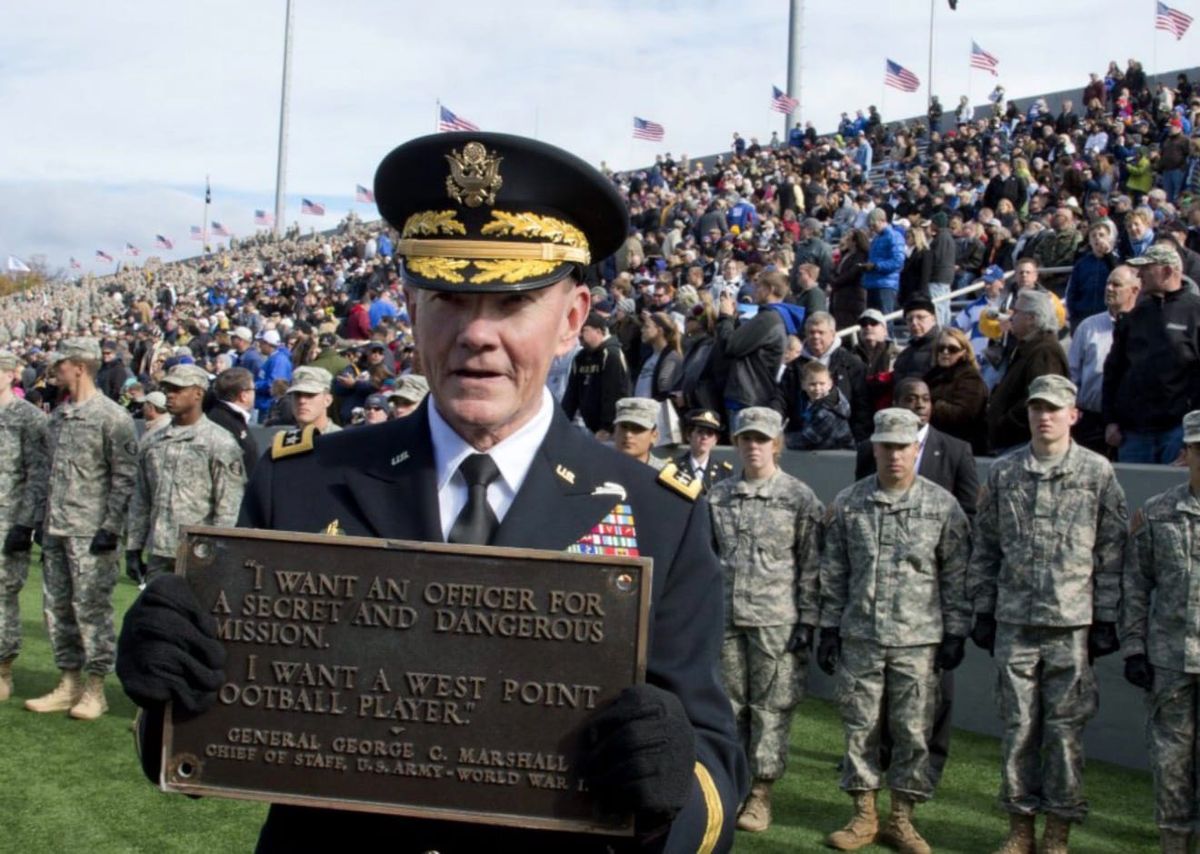
Chairman of the Joint Chiefs of Staff Gen. Martin E. Dempsey holds the Gen. George C. Marshall plaque prior to the start of the Army versus Air Force game in West Point, N.Y., Nov. 3, 2012.
There are few places in America more stirring in October than West Point. The military academy sits high on the bluffs above a bend in the Hudson River, on ground the Continental Army fortified to keep the British fleet from splitting the colonies, and in autumn the hills around it catch fire — maples and oaks turning every shade of amber and rust and burnt orange, the gray granite of the barracks going warm and gold in the slanting afternoon light. On a football Saturday the crowds climb the long slopes toward the stadium, and the walk has the unhurried hush of a procession. Far below, through the thinning trees, the Hudson lies flat and steel-blue and patient, the same river the first cadets watched two centuries ago. To make that climb on such a day is to feel something close to reverence — a sense that the ground itself is sacred.
There is a slab of bronze bolted to a wall at Michie Stadium, the football home of the United States Military Academy, and before every home game the Army players file past it and press their hands flat against the metal. Cast into the bronze is a single sentence, attributed to General George C. Marshall, the architect of Allied victory in the Second World War: “I want an officer for a secret and dangerous mission. I want a West Point football player.”
It is a stirring line, but there may be one small issue with it. Historians at the George C. Marshall Foundation will tell you, politely but plainly, that there is no record Marshall ever said it. The quotation reaches us thirdhand, relayed across decades through a chain of old soldiers’ memories, and it may well be apocryphal.
And yet the cadets keep touching the plaque. Generation after generation, on their way to the field, they lay a hand on words their own historians cannot verify — because whether or not Marshall spoke the words, the conviction behind them is something the American military has believed, fervently and continuously, for more than a century. The conviction is this: that the playing field is a rehearsal for the battlefield. That the habits a young person builds inside the white lines — the teamwork, the composure, the refusal to quit while there is time left on the clock — are the same habits that keep soldiers alive, and keep missions from failing, when the stakes are no longer a trophy.
This series is about that conviction, and about a handful of men in whom it was tested all the way to the end.
The Fields of Friendly Strife
No one held the belief more fervently than General Douglas MacArthur.
A West Point graduate and, after the industrial slaughter of the First World War, the academy’s superintendent, MacArthur returned to the school in 1919 convinced that the next war would be won or lost by junior officers — by lieutenants and captains making fast, irreversible decisions under unbearable pressure. He could not manufacture that capacity in a classroom. So he turned to sport. MacArthur made athletic competition compulsory for every cadet, and above the doors of the cadet gymnasium he ordered four lines carved into stone. West Point plebes still commit them to memory in their first weeks in uniform: “Upon the fields of friendly strife are sown the seeds that, upon other fields, on other days, will bear the fruits of victory.”
The conviction was not merely sentimental, and it left a paper trail. Decades later, when reporters at Army Times set out to test the old folk wisdom that West Point football produced an outsized number of generals, they found the folk wisdom was true: the academy’s football alumni have risen to the senior ranks of the Army at a rate far out of proportion to their numbers. The pipeline the Marshall quotation describes turned out to be real, even if the quotation itself may not be.
What sport actually rehearses is a narrow and specific thing. It is not violence, and it is not hatred. It is the willingness to put the body under stress for the sake of the people on either side of you — to be exhausted, and outmatched, and behind, and to keep going anyway, because quitting would betray a teammate. A game asks for that willingness in a small, bounded, gloriously survivable way. It hands out the lesson with the stakes set near zero. War asks for the very same willingness with the stakes set at everything. The men in this series are all at once the proof of the idea and the rebuke to it — proof that the discipline of the field genuinely transfers, and a reminder that the two arenas are not remotely the same, because only one of them sends people home under a folded flag.
Decoration Day
Which is the other half of this story, and the older half.
On the last Monday of every May, the United States observes Memorial Day. For many Americans it now functions chiefly as a hinge — the unofficial start of summer, a three-day weekend of cookouts and mattress sales and beaches finally warm enough to use. But the holiday was born in grief, and on a scale that is difficult, even now, to hold in the mind.
It was born of the Civil War. That war killed an estimated 620,000 Americans — for a century and a half the deadliest war in the nation’s history, deadlier than every later American war combined for much of that span — and it left the country carpeted with fresh graves, North and South. In the immediate aftermath, communities everywhere — Black and White, in the defeated South and the victorious North — began visiting those graves each spring and decorating them with flowers. They called the observance Decoration Day.
In 1868 it was given a national shape. On May 5 of that year, General John A. Logan — a former Union general who commanded the Grand Army of the Republic, the great fraternal order of Union veterans — issued General Order No. 11. He designated May 30 “for the purpose of strewing with flowers or otherwise decorating the graves of comrades who died in defense of their country.” The date was deliberate. May 30 was not the anniversary of any particular battle, so it could belong to all the dead at once, and it fell late enough in spring that flowers would be in bloom across the whole of the country. The first national observance was held that day in 1868 at Arlington National Cemetery — on the grounds of a confiscated Confederate estate that had already begun its long second life as the most sacred ground in American memory.
The origins are tangled and contested, as origins of this weight usually are. More than two dozen American towns have claimed to have held the first Memorial Day; in 1966 the federal government formally designated Waterloo, New York, as the holiday’s birthplace, though historians still argue the point. The holiday’s true beginning is probably not a single place at all, but a shared national instinct, acted upon in a thousand cemeteries at once.
What is not contested is how the holiday grew. After the First World War, Decoration Day’s meaning widened: it ceased to belong only to the Civil War dead and became a day for all Americans killed in all the nation’s wars. In 1971, under the Uniform Monday Holiday Act, it became an official federal holiday, anchored permanently to the last Monday in May, and the name Memorial Day — long in informal use — became the formal one. Strip away the long weekend, though, and the assignment General Logan handed the country in 1868 has never once changed: find the graves, decorate them, and say the names aloud, so that the dead are mourned as the specific and irreplaceable people they were, and not merely tallied.
The Little Brother of War
And here a third thread enters — improbably at first, and then, the longer you look at it, inevitably.
On that same last Monday of May, college lacrosse plays its national championship game.
For four decades the NCAA Division I men’s lacrosse final has been contested on Memorial Day; the 2026 edition marks the 40th consecutive year. The national semifinals are played on the Saturday, the lower-division finals across the weekend, and the Division I title game stands alone on the holiday itself as the last act. Since 2003, the championships of all three NCAA divisions have been folded into a single three-day festival. This year that festival comes to the University of Virginia, with games at Scott Stadium in Charlottesville from May 23 to May 25. Tens of thousands of people will be in the stands. It is, by a wide margin, the biggest weekend the lacrosse community will come together.
That lacrosse in particular should crown its champion on Memorial Day is less a quirk of the calendar than a kind of rhyme — and the rhyme runs deep. Lacrosse is the oldest team sport on the continent. It is not a European import but a North American original, the creation of Native American nations, the Haudenosaunee — the Iroquois — foremost among them. They did not regard it as a game in the modern, recreational sense. They knew it as the Creator’s Game; they played it as ceremony and as medicine, as thanksgiving and as healing, and at times as a means of settling disputes and of steeling young men for the discipline of conflict. Early European observers, watching hundreds of players surge across miles of open ground, gave it a blunter name. They called it the little brother of war.
When the modern, codified game took root in the United States in the late nineteenth and early twentieth centuries, it took root first and deepest in a particular set of places: at Johns Hopkins in Baltimore, at the United States Naval Academy in Annapolis, and at the United States Military Academy at West Point. Two of the sport’s founding powers were, quite literally, schools for war. From the beginning, American lacrosse and the American officer corps grew up in the same soil. So when the sport gathers each Memorial Day weekend to find out who is best, it is not borrowing a solemnity it has not earned. The game has been entwined with service, and with sacrifice, since long before there was an NCAA to organize it.
Go to Annapolis each July and you can watch that same marriage of the game and the uniform play out on the street. The old Maryland port is one of the great summer capitals of youth lacrosse, and when the club tournaments descend, its narrow Colonial streets — brick and cobblestone, laid down before the Revolution — flood with players and their families: teenagers in the travel-team jerseys of clubs from Long Island and Baltimore, and from Boston to Southern California, a moving collage of every imaginable color, sticks slung over their shoulders, drifting from gift shop to ice cream parlor while their parents slip inside one of the age-old establishments for a cold drink against the heat. Threaded among them, unmistakable in their summer whites, walk the midshipmen of the United States Naval Academy. Down at the City Dock the harbor is a clutter of masts and hulls — sailboats and skiffs and weathered workboats and the occasional gleaming yacht — and just beyond the water’s edge rise the domed, dignified Beaux-Arts buildings of the Academy itself, where for more than a century the Navy has been turning college students into officers. It is about as untroubled as an American summer afternoon gets — and that ease, this weekend above all, is worth recognizing for what it is: something bought and paid for in full.
How the Sport Remembers Its Dead
Nowhere is that entwining more visible than in the way the sport of lacrosse remembers the fallen.
At Johns Hopkins — a historic lacrosse powerhouse in Baltimore — a Veterans Memorial Wall now stands inside the Cordish Lacrosse Center, dedicated in 2022 to honor eleven former Blue Jays killed in action: men lost in the trenches of the First World War, the global struggle of the Second, and the jungles of Vietnam. Their names are set there alongside gold stars, the seals of the armed services, and a folded American flag enclosed in a triangular case — a permanent ledger etched into the very home of the game. The wall is itself the echo of an older, living tradition, one that dates back to 1919: each spring, before the first home game on Homewood Field, a Hopkins senior carries the gold-star service flag onto the grass and fastens it to the goal — a star upon it for every man who did not come back, a silent roll call before the opening faceoff.
Each year, as the college season reaches its Memorial Day finale, the sport hands out its individual honors — and two of the oldest among them are named for men killed in America’s wars. The Lt. Raymond Enners Award, first presented in 1969, goes to the Division I men’s player of the year. The Jack Turnbull Award goes to the country’s finest attackman. Lacrosse’s most famous modern prize, the Tewaaraton Award — created in 2001 and often called the Heisman Trophy of lacrosse — takes its name from the Mohawk word for the game itself, a nod to the sport’s Indigenous origins. But the Enners and the Turnbull are older, and they carry a different kind of weight: to win one is to have your achievement recorded forever beneath the name of a player who died in uniform.
Raymond Enners was a lacrosse player from Long Island who went to West Point. He was killed in Vietnam in 1968, at the age of 22, shot down crossing open ground in an attempt to reach a wounded soldier. Jack Turnbull was the greatest attackman of the 1930s and the captain of the United States Olympic lacrosse team. He was killed in 1944, flying a bomber over occupied Europe.
And it is not only those two. The honor for the nation’s finest midfielder carries a fallen man’s name as well. The Lt. Donald MacLaughlin Jr. Award is named for a Navy midfielder who was, in his day, among the very best in the country — a First-Team All-American who helped the Naval Academy win three consecutive national championships in the early 1960s. MacLaughlin graduated from Annapolis in 1963 and was commissioned a naval officer. Three years later, in 1966, he was killed on a combat mission in Vietnam.
The goalkeepers have their own. The Ensign C. Markland Kelly Jr. Award, given each year to the best goaltender in the college game, remembers a Baltimore boy who tended goal for the University of Maryland. In the autumn of 1940, with the world at war and America’s entry drawing near, Kelly left school to become a Navy pilot. He earned his wings, was commissioned an ensign, and was assigned to a fighter squadron aboard the carrier USS Hornet. On June 4, 1942, flying a Wildcat to escort the Hornet’s bombers, Ensign Kelly did not return from the opening strike of the Battle of Midway. He was never found.
Read that again, slowly, because it is the hinge of this entire series. Four of the most storied individual prizes in American lacrosse are named for men who were killed in America’s wars. They are, in effect, headstones with trophies bolted to them. And every spring, on Memorial Day weekend, the best players alive walk to a podium in front of a roaring crowd and accept an award engraved with the name of a player who never got the chance to grow old. Most of the crowd does not know the names are the names of the dead. This series is so that they will.
The Eight
Over the seven articles that follow, we tell their stories in full — eight athletes, across four wars and one terrible Tuesday morning in New York City on September 11, 2001, who learned something on a field and then carried it the rest of the way.
There is Brendan Looney, who arrived at the Naval Academy having never held a lacrosse stick, willed himself into an All-American defenseman, and then became a Navy SEAL — graduating first in his SEAL training class while privately grieving Travis Manion, his Academy roommate and closest friend, already lost to the war in Iraq. Looney was killed in a helicopter crash in Afghanistan in 2010, ten days before he was due home. At Annapolis, the number he wore, 40, is now the highest honor a Navy lacrosse player can be given.
There is Jimmy Regan of Manhasset, New York — a Chaminade and Duke midfielder with a place waiting for him at law school, who chose instead to enlist as an Army Ranger. He was killed in Iraq in 2007. A photograph taken at his grave in Arlington that Memorial Day, of the fiancée he left behind, became one of the most quietly shattering images of the wars.
There is Michael Murphy of Patchogue, on Long Island — the boy his middle-school classmates nicknamed “the Protector” after he stepped between a bully and a defenseless child. His last stand, leading a four-man SEAL team ambushed in an Afghan canyon during Operation Red Wings in 2005, earned the first Medal of Honor awarded in the war in Afghanistan.
There is Pat Tillman, who walked away from a multimillion-dollar contract with the NFL’s Arizona Cardinals to enlist as an Army Ranger, and who pointedly refused to say a single public word about why. He was killed in Afghanistan in 2004 — and the Army, for weeks, did not tell his family or the country the truth about how.
There is Jack Turnbull, the Baltimore attackman who stood atop the entire lacrosse world in 1932 and was dead over Europe twelve years later — a champion the war took exactly as readily as it took everyone else.
There is Raymond Enners, “the Machine,” the Long Island schoolboy star turned West Point lacrosse standout turned infantry lieutenant, killed in Vietnam in the act of trying to save one of his own men.
And there is the single September morning that took two lacrosse men at once: Welles Crowther, the Boston College player who tied a red bandana over his face and climbed back up into a burning tower again and again until it fell; and Eamon McEneaney, perhaps the most gifted player Cornell University ever produced, a man who had led some sixty colleagues out of those same towers once before and was not granted the chance to do it twice.
Saying the Names
They did not all play lacrosse. Tillman was a football player; Murphy’s arenas were the hockey rink and the lifeguard’s chair. They did not all die in uniform: Crowther and McEneaney were civilians, killed in an attack on an ordinary workday, on no battlefield at all. This series gathers them anyway, because they are bound by the older and larger idea that the bronze plaque at West Point was reaching for, clumsily, in its talk of football players. Every one of them had learned, somewhere with a scoreboard and a final whistle, how to spend himself for the people beside him. And every one of them, when the moment arrived that asked for the real and unbounded version of that lesson, met it without having to stop and decide what kind of person he was going to be.
This weekend, the games in Charlottesville will be magnificent. They should be. The young men on that field have given years of their lives to reach it, and the sport they play is fast and beautiful and worth every decibel of the noise. On Monday evening there will be a champion, and a player will lift a trophy over his head, and somewhere in the roar a public-address announcer will read out the name on an award — Enners, or Turnbull — and the stadium will cheer without quite knowing whom it is cheering, or what the name once cost.
That is not a failure of the crowd. It is simply the work that Memorial Day exists to do, and that this series hopes to do a small part of: to turn a name back into a person. To say who Raymond Enners was, and Jack Turnbull, and the six others — where they were raised, how they came to their sport, why they put on the uniform, how they died, and how they are held in memory now.
Because the games always end. The final whistle will blow, the horn will sound, a champion will be crowned, and the long weekend will be folded up and put behind us for another year. The names, however, do not disappear. We only have to remember them.

Comments ()