Musk’s Own Cap Table and Grok Admission Rock OpenAI Trial’s First Week
51% equity exhibit, xAI distillation revelation, and “Law 101” quip punctuate three days of bruising testimony in Oakland.
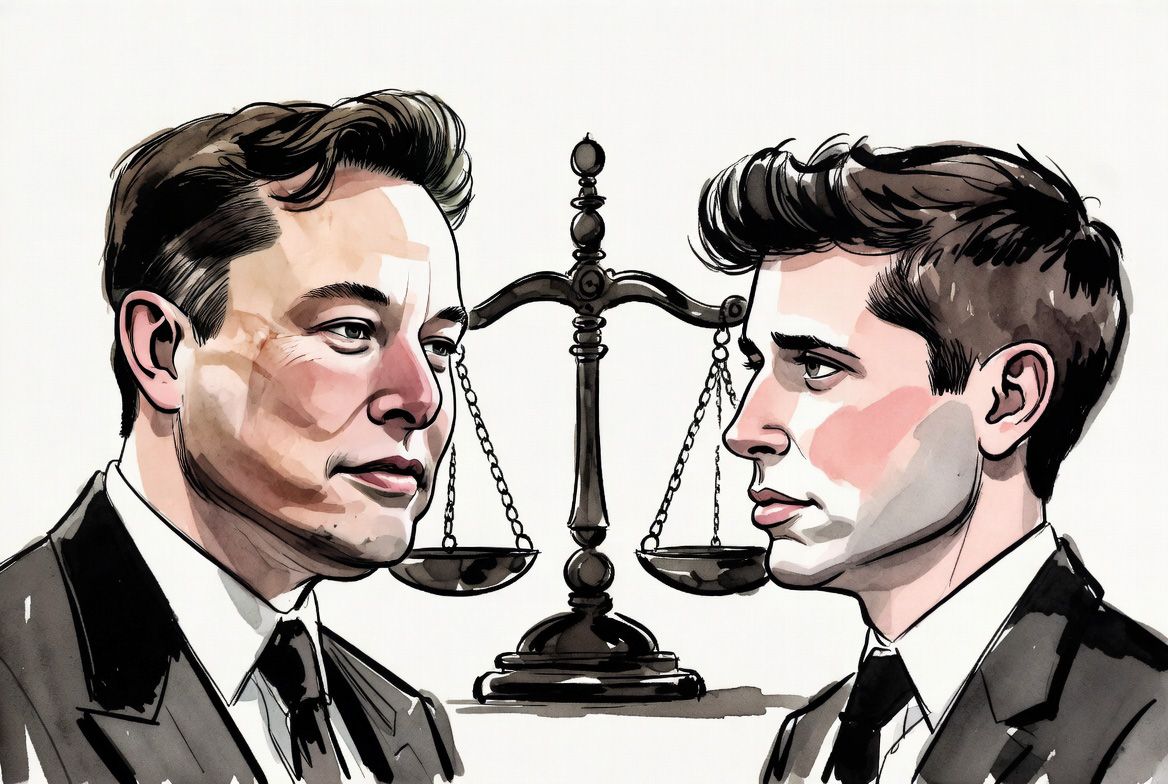
OAKLAND, Calif. — The week that began with Elon Musk describing himself as a betrayed benefactor ended with a spreadsheet of his own making planted on the courtroom screen. During cross-examination, William Savitt, OpenAI’s lead attorney, attempted to narrow Musk’s charity-theft position into something considerably more complicated: a control-loss story.
Typical of complex trials, the bruising direct and cross-examination produced dramatic swings that cannot be fully evaluated until all witnesses have taken the stand.
A nine-person advisory jury heard three full days of Musk’s testimony in the Ronald V. Dellums Federal Courthouse before the court entered a scheduled Friday recess. Proceedings resume Monday, May 4, with the testimony of Jared Birchall — the managing director of Musk’s family office, Excession LLC — and potentially AI safety expert Dr. Stuart Russell of U.C. Berkeley.
The case, brought in 2024, centers on whether OpenAI’s transformation from a nonprofit into a commercially dominant enterprise backed by billions in Microsoft funding violated the terms and charitable intent of its 2015 founding. Musk is seeking structural remedies — the removal of Sam Altman and Greg Brockman from leadership, a reversion to nonprofit governance — and damages exceeding $130 billion to be redirected into OpenAI’s nonprofit arm. Only two claims survived pretrial rulings: breach of charitable trust and unjust enrichment. The jury’s verdict is advisory only. Judge Yvonne Gonzalez Rogers will render the final legal determination, expected by mid-May.
👉 Follow Short Stop Media to get inside the courtroom — not just the headlines.
Sharp, factual breakdowns of the Musk–Altman trial and the biggest legal battles shaping the future of AI.
The Grok Admission
The week’s most startling moment came Thursday, when Savitt asked Musk whether his AI company xAI had used distillation techniques on OpenAI models to train Grok, its competing chatbot. Musk said the answer was “partly,” and characterized the practice as standard across the industry. Audible gasps were reported from the gallery. The man suing OpenAI for commercializing what he had donated had, in a single answer, acknowledged that his own company was training on OpenAI’s outputs. The irony was not lost on the packed courtroom — or on the army of Bay Area tech reporters covering every word.
The Cap Table on the Screen
Savitt’s most damaging exhibit was a 2017 spreadsheet prepared by Jared Birchall, the very witness now waiting to testify on Musk’s behalf. It showed Musk holding 51.20 percent of the equity in a proposed for-profit OpenAI structure, with Altman, Sutskever and Brockman at 11.01 percent each, and Musk commanding four of seven board seats. The argument that OpenAI’s commercialization was a betrayal of its founding ethos collided visibly with evidence that Musk himself had once contemplated majority ownership of the very commercial structure he now condemns. Musk pushed back, asserting that his proposed control would have decreased over time. The exhibit had already landed.
The Pledge He Never Fulfilled
Musk confirmed on the stand that he never fulfilled his original $1 billion funding commitment to OpenAI, ultimately contributing $38 million before his 2018 departure. He attributed this to lost confidence in the team. “I was a fool who provided them free funding to create a startup,” he told the jury, framing that $38 million as seed capital for what became an $800 billion company. OpenAI’s counsel argued that Musk left not out of principled concern but after his bid to take control of the organization — or absorb it into Tesla — was rejected by his fellow founders.
The Sparring
The courthouse was packed throughout the week with armies of lawyers carrying boxes of exhibits, journalists typing at their laptops, and a handful of concerned OpenAI employees. Outside, protesters lined the streets carrying signs urging people to quit ChatGPT, boycott Tesla, or both. Musk looked calm and comfortable on the stand, slipping in the occasional quip in his distinct South African accent. Altman sat a few feet away holding a small notebook and a pen. Brockman took notes on a yellow legal pad in red ink.
The cross-examination grew combative. Musk accused Savitt of crafting questions intended to “trick” him and refused to give yes-or-no answers he deemed misleading. Savitt pressed him on a 2017 email Musk sent to a Tesla vice president after poaching Andrej Karpathy, a founding OpenAI member: “The OpenAI guys are gonna want to kill me.”
He pressed him on why xAI, which Musk founded in 2023, sued the state of Colorado over an AI safety law designed to prevent algorithmic discrimination — an awkward posture for a self-described safety crusader. He pressed him on a March 2026 tweet in which Musk had written that Tesla would be “one of the companies to make AGI” — moments after Musk had told the jury Tesla was not pursuing artificial general intelligence.
When Musk’s lawyer, Steven Molo, implored the judge to allow expert testimony on AI existential risk — raising his voice to declare “We all could die as a result of artificial intelligence!” — Judge Gonzalez Rogers was brisk: “This is not a trial on whether or not artificial intelligence has damaged humanity.” She then added the line that drew the loudest reaction of the week: “It’s ironic your client, despite these risks, is creating a company that is in the exact space.”
At the end of cross-examination, the judge reprimanded Savitt for cutting off Musk’s answers, then turned and reminded the jury that Musk “has not taken a class in evidence.” Musk retorted that he had, technically, taken “law 101.” Laughter filled the courtroom.
👉 This story isn’t over.
Follow Short Stop Media to see every twist in the Musk vs. OpenAI trial — with clear analysis you won’t get anywhere else.
The Judge: Yvonne Gonzalez Rogers
When Yvonne Gonzalez Rogers was 10 years old, she sat on the witness stand and testified in her parents’ messy divorce proceeding — an unpleasant but life-changing experience that she has credited with drawing her into the law. Born and raised in Texas, she graduated cum laude from Princeton University and took her law degree from the University of Texas, completing her final year at U.C. Berkeley School of Law. She spent more than a decade as an equity partner at Cooley LLP in San Francisco, specializing in business and real estate litigation, before Governor Arnold Schwarzenegger appointed her — a Democrat — to the Alameda County Superior Court in 2008.
President Obama elevated her to the federal bench in 2011; the Senate confirmed her 89 to 6. She is the first Latina to serve as a federal judge in the Northern District of California, and is best known nationally for presiding over Epic Games v. Apple. In this proceeding she has maintained an iron grip on scope, decorum and pace, tolerating neither theater nor digression from either side.
For the Plaintiff: Steven Molo of MoloLamken LLP
Steven Molo began his legal career as a federal prosecutor in Chicago, then built his reputation as a senior litigator at Winston & Strawn before spending five years as a litigation partner at Shearman & Sterling on Wall Street. In 2009 he co-founded MoloLamken, a lean boutique that Chambers & Partners calls home to “a fabulous courtroom litigator who lights up the room with his presence” and that Benchmark Litigation ranks among the top 100 trial lawyers in America.
Molo opened this trial by urging the jury to set aside their feelings about his client — “Everybody seems to know Mr. Musk and have an opinion of Mr. Musk. Not everybody’s opinion is good, not everybody’s is bad” — and spent three days building Musk’s account of a charity stolen.
His most memorable courtroom moment was also his least successful: imploring the judge to allow AI extinction-risk testimony, he raised his voice and declared, “We all could die!” The judge shut it down in under ten seconds.
For the Defense: William Savitt of Wachtell, Lipton, Rosen & Katz
William Savitt’s path to the lectern wound through a New York rock band that played CBGB, a cab-driving interlude to fund it, a Columbia Ph.D. attempt in French legal history, law school, a clerkship for Justice Ruth Bader Ginsburg, and a partnership at Wachtell, Lipton, Rosen & Katz — consistently ranked the most profitable law firm in the United States per partner and the preeminent firm in major corporate governance battles.
Savitt graduated from Columbia Law School in 1997, where he was editor-in-chief of the Columbia Law Review, and now co-chairs both the firm’s Executive Committee and its Litigation Department.
His Musk file has layers: he once defended Musk and Tesla in a securities-fraud matter over the SolarCity acquisition, then crossed to represent Twitter when Musk tried to exit his $44 billion acquisition deal. After that deal closed, X sued Wachtell for $90 million in fees — a case dismissed last year. This week, cross-examining a man he once defended, Savitt deployed a decade of Musk’s own correspondence with surgical precision. His closing question — asking Musk about OpenAI’s various nonprofit activities — ended with Musk conceding: “I don’t know what’s going on at OpenAI.” It was a clean, quiet finish.
Looking Ahead to Week Two
Birchall’s testimony resumes Monday on the mechanics of Musk’s donations, though the judge’s skepticism about its scope may limit its usefulness to the plaintiff. AI safety expert Dr. Stuart Russell of UC Berkeley is expected on the stand, though the judge has made clear his testimony will be tightly cabined.
The defense has yet to call a single witness — Altman, Brockman, former executives Ilya Sutskever and Mira Murati, and potentially Microsoft’s Satya Nadella all remain in the queue. The judge is targeting a mid-May conclusion.
👉 If you care about law, power, and the future of AI — this is your briefing.
Join readers getting smart, no-noise analysis delivered straight to their inbox.


Comments ()