$75 Billion. $1.75 Trillion. And a Bet on Mars.
SpaceX has filed the largest IPO in history, is set to price on June 11 and begin trading June 12. Here is everything investors and Americans need to know before the bell rings.
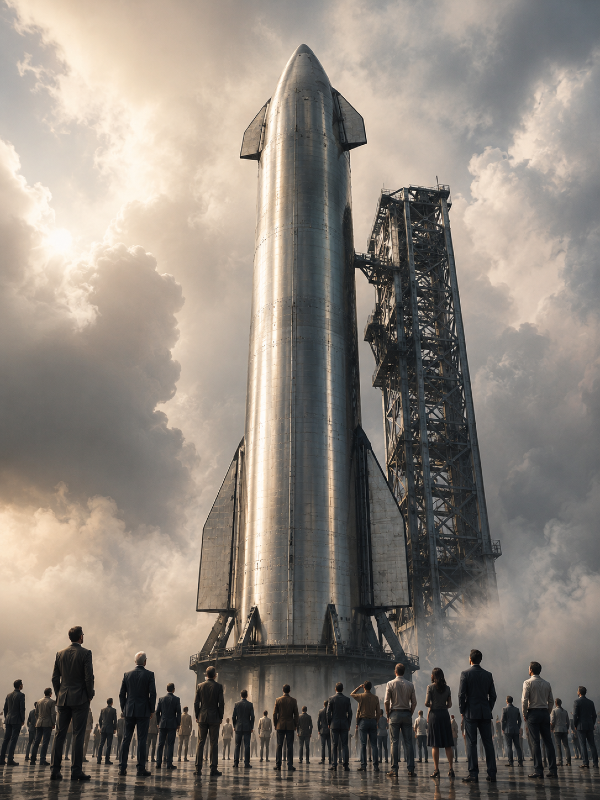
SPECIAL REPORT: SPACE X IPO
PART 1
PART ONE: THE MOMENT ARRIVES
From Garage to Galaxy — The IPO That Will Change Everything
On June 12, 2026 — six days from today — a company that began with a single engineer, a borrowed desk in El Segundo, California, and a founder who had just sold an online payment processor is expected to begin trading on the Nasdaq Stock Exchange under the ticker symbol SPCX. Space Exploration Technologies Corp. — SpaceX — has set its initial public offering price at $135 per share, is offering 555.6 million Class A shares, expects to raise $75 billion in new capital, and is targeting a total equity valuation of approximately $1.75 trillion.
Let that number sit for a moment. One point seven five trillion dollars. That is more than the gross domestic product of Canada. It would make SpaceX the seventh most valuable company in America, trailing only Apple, Nvidia, Microsoft, Alphabet, Amazon, and Meta. At the targeted raise of $75 billion, it would be three times the capital raised by Alibaba in 2014, which still holds the record for the largest U.S. IPO. It would nearly triple the $25.6 billion Saudi Aramco raised in 2019 in the largest global listing ever recorded. If it prices as expected, SpaceX’s IPO will be the single most significant capital markets event in the history of American finance.
The roadshow that began June 4 is now in full swing. Approximately 125 analysts from 21 participating underwriting banks are meeting SpaceX management. A dedicated event for roughly 1,500 retail investors is planned for June 11 — the same day as final pricing. The institutional book is being built. Retail platforms including Fidelity, Charles Schwab, Robinhood, SoFi, and E*Trade are accepting indications of interest from individual investors. Six days from now, the bell will ring.
What SpaceX is offering investors in this historic transaction is not merely a stake in a rocket company. The S-1 registration statement filed with the Securities and Exchange Commission on May 20, 2026 makes clear that this is a stake in a vertically integrated empire spanning three distinct business lines — space launch, satellite broadband connectivity, and artificial intelligence — that together claimed $18.7 billion in 2025 revenue and are growing at a pace that has left Wall Street reaching for new vocabulary to describe it.
It is also an offering packed with complexity, controversy, and risk. The company’s chief executive simultaneously runs Tesla, the Boring Company, Neuralink, and recently served as a “special government employee” leading the Department of Government Efficiency. The company carries a $41.3 billion accumulated deficit. Its AI segment lost $6.355 billion in 2025 alone. Its Starship rocket — the central pillar of virtually every long-term revenue projection in the filing — has not yet reached commercial operational status. And investors in Class A shares will acquire precisely one vote per share in a company where Musk is expected to retain more than 82 percent of the total voting power. Morningstar analysts have pegged SpaceX’s fair value at approximately $780 billion — roughly half the IPO target — cautioning that the valuation bakes in a vast amount of future that has yet to occur.
This is what it looks like when the most visionary industrial company in the world decides to go public. Beautiful and complicated, breathtaking and hazardous, potentially the investment of a generation or the most expensive science project in financial history. What follows is a complete account of the twenty-five most important things every investor and every American needs to understand before SpaceX begins trading.
PART TWO: THE TOP 25 THINGS YOU MUST KNOW
1. The Largest IPO in the History of American Capital Markets — If It Prices As Expected
The numbers are extraordinary. SpaceX plans to raise $75 billion in its IPO — three times the capital raised by Alibaba, which for twelve years has held the record for the largest U.S. IPO. The offering prices 555.6 million Class A shares at $135 per share, placing the company’s total equity valuation at approximately $1.75 trillion at the target price. The prior record for funds raised in a U.S. IPO was Alibaba’s $21.8 billion in September 2014. SpaceX seeks to eclipse that by more than three and a half times. Saudi Aramco’s $25.6 billion global record from December 2019 would be bested by nearly three times. The underwriting syndicate reflects the magnitude: 21 banks in the book, led by Goldman Sachs, Morgan Stanley, Bank of America, Citigroup, and JPMorgan Chase.
2. Three Companies in One: Space, Starlink, and AI
The prospectus is built around three business segments, each of which would be a major standalone enterprise in its own right. The first is the Space segment — rocket launches, crew missions, cargo transport, Starship development. The second is the Connectivity segment, anchored by Starlink, the global satellite broadband network. The third, and most recently added, is the AI segment, incorporating xAI (the artificial intelligence company Musk founded in 2023), Grok (the frontier AI model), and X (the social media platform formerly known as Twitter). These three divisions have wildly different economic characteristics — and currently only one of them is profitable.
3. Starlink Is the Economic Engine — and the Only Profit Center
The financial story of SpaceX today is the story of Starlink. The Connectivity segment generated $11.387 billion in revenue in 2025 — up 49.8 percent year-over-year — and posted $4.423 billion in operating income and $7.168 billion in Adjusted EBITDA. Operating income grew an astonishing 120.4 percent in a single year. In Q1 2026, Connectivity delivered $3.257 billion in revenue and $1.188 billion in operating income. No other segment comes close. As of March 31, 2026, Starlink serves 10.3 million active subscribers across 164 countries, served by approximately 9,600 satellites — roughly 75 percent of all active maneuverable satellites in Earth orbit.
4. The Space Segment Loses Money — By Design
Counterintuitively, the division that gave SpaceX its name is not currently profitable. The Space segment generated $4.086 billion in revenue in 2025 but posted a $657 million operating loss, because it funded $3.004 billion in Starship R&D in 2025 alone. Starship — SpaceX’s fully reusable super heavy-lift rocket — is the key to virtually every long-term revenue projection in the filing. SpaceX is using Starlink’s profits to fund the most expensive engineering program in private history. Q1 2026 Space revenue was $619 million with a $662 million operating loss, as Starship development costs have accelerated.
5. The AI Segment Is a Capital Furnace
The AI segment — xAI, Grok, and X — posted $3.201 billion in revenue in 2025 but lost $6.355 billion from operations. Capital expenditures for AI were $12.727 billion in 2025 and $7.723 billion in Q1 2026 alone — more than SpaceX spent on rockets and satellites combined in the same period. This is a deliberate, aggressive race to build what the company believes is the computing infrastructure of the future. The AI segment’s operating losses will likely remain substantial for years before the infrastructure reaches the scale needed to generate returns.
6. The $28.5 Trillion Total Addressable Market Claim
The S-1 contains one of the most ambitious market-sizing claims in IPO history: SpaceX asserts a quantifiable total addressable market of $28.5 trillion — exceeding the annual GDP of the United States. Of that, $370 billion sits in Space, $1.6 trillion in Connectivity, and $26.5 trillion in AI — dominated by $22.7 trillion in enterprise AI applications. Critics, including Morningstar analysts, note that this TAM assumes enormous market creation that has not yet occurred, including in-orbit manufacturing, Mars transport, and asteroid mining — industries that, the S-1 itself acknowledges, “do not exist today.” Whether one views this as bold vision or promotional excess depends largely on one’s assessment of Musk’s historical track record.
7. The Valuation Debate: $1.75 Trillion vs. $780 Billion
The pricing of this offering is genuinely contested. SpaceX is marketing at $1.75 trillion — a price-to-sales multiple of approximately 94x 2025 revenues and a price-to-sales ratio of roughly 103x on current annualized revenues. Morningstar’s equity research team has publicly placed SpaceX’s fair value estimate at approximately $780 billion — roughly half the IPO target — reflecting the uncertainty around AI segment profitability, Starship’s commercial development timeline, and the speculative nature of future markets like orbital compute, lunar infrastructure, and Mars. The gap between Morningstar’s $780 billion and SpaceX’s $1.75 trillion target is the central debate of this offering: investors who price this company on current earnings look at one number; investors who price it on what Musk builds next look at another.
“Morningstar values SpaceX at ~$780 billion — roughly half the IPO target. The gap between those two numbers is the central debate of this offering.”
8. The Dual-Class Share Structure and the Governance Question
SpaceX will go public with Class A shares carrying one vote per share and Class B shares carrying ten votes per share. Musk holds the substantial majority of Class B shares and is expected to retain more than 82 percent of the total voting power while owning approximately 42 percent of the economic equity. Class B shareholders also have the exclusive right to elect a majority of the board. This means Class A investors will have virtually no ability to influence how the company is run. SpaceX will be designated a “controlled company” under Nasdaq rules, exempting it from requirements for majority-independent board composition and independent compensation and nominating committees.
9. Musk’s Pay Package: The Most Ambitious in Corporate History
The SpaceX board has granted Musk 1 billion restricted Class B shares on top of his existing approximately 5 billion shares — a new grant potentially worth an additional $135 billion at the IPO price, and far more if the company reaches milestone targets. The full performance package — estimated by Bloomberg at more than $760 billion in total potential value — vests only if SpaceX reaches a peak market capitalization of $7.5 trillion AND establishes a permanent human colony on Mars with at least one million inhabitants. No public company has ever tied executive compensation to establishing a human civilization on another planet.
10. The xAI Merger: SpaceX Now Includes an AI Company and Twitter
Three months before filing its S-1, SpaceX completed the acquisition of xAI Holdings Corp. in an all-stock transaction valued at $1.25 trillion combined — SpaceX at $1 trillion, xAI at $250 billion — the largest private corporate merger in history. That deal also folded in X (formerly Twitter), which xAI had absorbed in March 2025. The S-1 financials are retroactively recast to present all three as a single company. The result is something without precedent: a public offering covering rockets, global broadband internet, a frontier AI model, and a real-time social platform with 550 million monthly active users.
Short Stop Media is following every major development involving SpaceX, OpenAI, Anthropic, xAI, and the rapidly evolving AI economy. Subscribe for free to receive future reports, SEC filing analysis, and IPO coverage as events unfold.
11. Anthropic Is Paying SpaceX $1.25 Billion Per Month for Compute
In May 2026, Anthropic — the AI safety company and SpaceX’s primary competitor in the frontier AI space — entered into a Cloud Services Agreement to access capacity at SpaceX’s COLOSSUS data centers in Memphis, Tennessee. The price: $1.25 billion per month through May 2029, annualizing to $15 billion per year. The relationship illustrates both SpaceX’s strength as a compute infrastructure provider and the extraordinary global scarcity of frontier-scale AI computing capacity. It also means one of SpaceX’s primary AI competitors is directly funding SpaceX’s infrastructure buildout.
12. The Cursor Option: A $60 Billion AI Coding Bet
In April 2026, SpaceX entered an agreement with Cursor (Anysphere, Inc.), the AI-powered coding assistant, granting SpaceX the option to acquire the company at an implied equity value of $60 billion in Class A stock. If SpaceX terminates the option, it owes Cursor $1.5 billion in termination fees plus $8.5 billion in deferred services fees — $10 billion simply for walking away. The strategic rationale: AI-assisted software development generates context-rich, verifiable training data at scale, and Cursor’s integration with developer workflows provides a continuous stream of real-world AI usage data.
13. Orbital AI Compute: The Moonshot Inside the Moonshot
Beginning as early as 2028, SpaceX intends to deploy satellites equipped with AI processors into Sun-synchronous orbit — effectively data centers in space powered by solar arrays. The logic: solar energy in space is continuous, unobstructed, and five times more energy-dense per unit area than terrestrial solar. SpaceX contemplates deploying 100 gigawatts of orbital compute capacity annually, which would require thousands of Starship launches per year and the transport of approximately one million metric tons to orbit annually. This is a multi-decade industrial undertaking, and among the most important — and most uncertain — propositions in the filing.
14. 30 Percent Retail Allocation: Unusual Access for Individual Investors
SpaceX has reserved approximately 30 percent of the IPO float for retail investors — three times the typical allocation for a mega-cap offering. Retail platforms including Fidelity, Schwab, Robinhood, SoFi, and E*Trade are accepting indications of interest. Investors can request as few as one share or as many as one million, subject to allocation based on demand. A dedicated investor event for approximately 1,500 retail participants is planned for June 11, the pricing day. The 30 percent retail allocation reflects Musk’s stated belief that ordinary Americans should have access to invest in America’s future.
15. Index Fund Forced Buying: Various Estimates of Billions in Mandatory Purchases
Nasdaq revised its index inclusion rules in May 2026, allowing newly listed companies ranked among the top 40 by market cap to enter the Nasdaq-100 after just 15 trading days. SpaceX will be weighted as though its free float is three times its actual public share count, capped at 33.3 percent. Analysts differ on the magnitude of the resulting passive demand.
Some estimate that passive index-related demand for SpaceX shares could ultimately reach between $22 billion and $27 billion, particularly if future inclusion in all of the major indexes is considered. Other analysts estimate Nasdaq-100 inclusion could require roughly $4.3 billion in passive buying, while the broader estimates of $22–27 billion included possible S&P 500 inclusion. But S&P Dow Jones has declined to fast-track SpaceX, delaying any S&P 500-related buying until at least 2027. Nevertheless, many Americans with broad U.S. equity index funds, retirement accounts, or Nasdaq-focused ETFs could find themselves owning SpaceX shares shortly after the IPO.
16. Government Dependency and the DOGE Conflict
Approximately 20 percent of SpaceX’s 2025 revenue came from U.S. federal agencies — making the company’s results materially dependent on government contracts. SpaceX is NASA’s primary launch provider for human missions to the ISS, holds more than $4 billion in Artemis lunar contracts, and is reportedly the frontrunner for a $2 billion Pentagon contract for the Golden Dome missile defense constellation. The complication: Musk spent the early months of 2025 as a “special government employee” leading DOGE, which had visibility into the agencies that regulate and fund SpaceX. Congressional investigators opened conflict-of-interest probes; an investor group wrote to the SEC urging scrutiny. The S-1 acknowledges the conflict directly.
17. The Risk Factors Run to 38 Pages — and Are Worth Reading
Starship dependency: Every major long-term revenue line depends on Starship achieving commercial operational status, which has not yet occurred.
Future dilution: SpaceX warns it “may issue a significant amount of equity in connection with future transactions” — including the potential $60B Cursor acquisition.
Musk’s attention: The S-1 explicitly identifies Musk’s multiple leadership roles as a material risk factor.
$530 million in legal exposure: Environmental litigation, employment matters, and other disclosed liabilities.
Space debris and collision risk: With 9,600 satellites in orbit and plans for many more, collision risk is materially elevated.
X debt burden: The $13 billion in debt from the Twitter acquisition now sits within SpaceX’s corporate structure, disclosed in the S-1.
18. Starship: The Key to Everything, Still Commercially Unproven
Starship — designed to carry 100 metric tons to Earth orbit in a fully reusable configuration — is the most consequential piece of technology in the SpaceX portfolio for the next decade. SpaceX has conducted 11 flight tests as of March 31, 2026, with a 12th scheduled. The company expects Starship to begin payload delivery to orbit in the second half of 2026. Next-generation V3 Starlink satellites — designed to offer one terabit per second of downlink capacity — can only be deployed on Starship. A single Starship launch can carry up to 60 V3 satellites, a twenty-fold increase in Starlink downlink capacity per launch compared to Falcon 9. Every major growth opportunity in the filing runs through this rocket.
19. COLOSSUS: The World’s Largest AI Training Cluster, Built in 122 Days
COLOSSUS, SpaceX’s AI training data center in Memphis, Tennessee, was brought online in 122 days from groundbreaking — versus an industry benchmark of approximately two years. COLOSSUS II came online even faster in 91 days. Together they provide approximately 1.0 gigawatt of computing power — currently the world’s largest coherent AI training cluster. The Terafab chip initiative — a collaboration with Tesla and Intel — aims to eventually produce one terawatt of compute hardware per year, giving SpaceX potential control over the AI compute supply chain that no other company, including Nvidia, currently possesses.
20. The Full Financial Picture: Three Numbers Every Investor Must Know
2025 Full Year: Revenue $18.674B | Operating Loss $(2.589B) | Adjusted EBITDA $6.584B | GAAP Net Loss ~$(4.94B) | Accumulated Deficit $(41.3B)
Q1 2026: Revenue $4.694B | Operating Loss $(1.943B) | Adjusted EBITDA $1.127B
2025 By Segment: Connectivity $11.387B revenue, $4.423B op. income | Space $4.086B revenue, $(657M) op. loss | AI $3.201B revenue, $(6.355B) op. loss
2025 Total Capex: $20.737B ($3.832B Space | $4.178B Connectivity | $12.727B AI)
Starlink generates the cash. The Space segment burns it building Starship. The AI segment burns even more building the compute infrastructure of a future that may be worth trillions — or may not arrive on schedule. On adjusted EBITDA, SpaceX generates meaningful positive cash flow. On GAAP, it posts substantial losses. Which metric dominates the trading narrative for SPCX will likely define its early months as a public company.
21. The Bull Case for $1.75 Trillion
The bull case begins with Starlink. At $7.168 billion in Adjusted EBITDA in 2025, growing at 86 percent year-over-year, Starlink alone can be valued as a hypergrowth technology company. At a 30x EBITDA multiple, Starlink alone is worth approximately $215 billion. At 40x, the number exceeds $280 billion. Add the launch business strategic value, the AI segment as an early-stage business with frontier infrastructure, and the optionality of orbital compute, lunar infrastructure, and Mars — and bull-case analysts arrive comfortably above $1 trillion. The argument is not primarily about current earnings; it is about what Musk has historically built and what the $28.5 trillion TAM, if even partially captured, implies for long-term value.
22. The Bear Case: What Could Go Wrong
Skeptics make several coherent arguments. First, Morningstar’s $780 billion fair value estimate — roughly half the offering price — implies significant overvaluation on any near-term horizon. Second, the AI segment is structurally loss-making and faces fierce, well-funded competition from Google, OpenAI, Anthropic, and Meta. Third, Starship remains commercially unproven; any meaningful delay cascades through every segment. Fourth, Musk’s divided attention across Tesla, xAI, Neuralink, the Boring Company, and formerly DOGE is a genuine governance risk that the S-1 acknowledges. Fifth, the New York State Office of the State Comptroller wrote to the SEC in May 2026 urging scrutiny, citing auditor independence concerns and related-party transaction complexity.
23. How SpaceX Compares to Other 2026 IPOs
SpaceX’s offering dominates what was expected to be a busy 2026 IPO class. OpenAI is reportedly targeting a valuation of approximately $840 billion; Anthropic is exploring a listing near $330 billion; Databricks at $134 billion; Stripe at an estimated $106–$159 billion in secondary markets. Klarna, Chime, and StubHub have filed or are considering filings. But SpaceX at $1.75 trillion dwarfs them all — it is more than twice OpenAI and five times Anthropic. Analysts warn that SpaceX’s $75 billion capital raise could “swallow the entire pie” of capital that was expected to fund a broader class of 2026 IPOs, constraining what remains for everyone else.
24. What SpaceX Has Actually Built: The Facts Behind the Valuation
Before the valuation models and the risk factors, it is worth stating what SpaceX has actually accomplished: approximately 650 orbital space missions with over 99 percent mission success rate. 78 astronauts transported from 20 countries to and from the ISS. More mass launched to orbit than any other company or nation in each of the last three years. The cost of reaching Earth orbit reduced by more than 85 percent from historical averages. A global satellite broadband network connecting 10.3 million customers across 164 countries, including communities in rural Africa, the Amazon basin, and the Pacific islands that had never before had reliable internet access. These achievements are documented, verifiable, and extraordinary by any fair standard.
25. The Bottom Line: What Kind of Investment Is This?
To buy shares in SpaceX at $135 is to make a specific kind of bet — one that requires holding in your mind simultaneously the extraordinary reality of what the company has built and the extraordinary ambition of what it is promising to build next. The financial metrics are complex and, by traditional valuation standards, stretched far beyond what conventional analysis would support. Morningstar puts fair value at $780 billion; the offering targets $1.75 trillion. The governance risks are real and concentrated in a single person also running five other enterprises. The AI segment is burning billions. Starship has not yet flown commercially. Mars is decades away.
And yet. Starlink is the fastest-growing internet service in the history of connectivity. COLOSSUS is the world’s largest AI training cluster, built faster and cheaper than any comparable facility. The Falcon 9 has flown a booster 34 times, a reusability record no competitor can match. The company’s mission is stated with a clarity and conviction that, in the history of great American enterprise, has occasionally proven to be not just inspirational rhetoric but an accurate description of what actually happened. SpaceX’s IPO is not for the risk-averse. It is, depending on your view, either the most consequential investment opportunity American public markets have produced in a generation, or the most expensive science experiment ever offered to retail investors. Pricing is June 11. Trading begins June 12. The stars await.
The prospectus can tell you what SpaceX is worth on paper. It cannot tell you what it means — for American power, for the global technology race, or for the question of what kind of future a single company is allowed to build. For that, five larger questions.
PART THREE: FIVE BIGGER QUESTIONS AFTER THE IPO
The numbers are staggering. The valuation debate is real. The risks are substantial. But after 300 pages of financial disclosures, twenty-five key facts, and endless discussion of market capitalization, several larger questions remain. They are questions not merely about an IPO, but about the future of technology, national power, and the role a single company may play in shaping both.
Is SpaceX Now a National Security Company?
For much of its history, SpaceX was viewed as an ambitious commercial launch provider. That description is no longer sufficient.
Today, SpaceX sits at the center of critical American infrastructure. It launches national security payloads for the United States government. It transports astronauts to and from the International Space Station. Its Starshield division provides military and intelligence capabilities built upon the same satellite architecture that powers Starlink. In many respects, SpaceX has become as strategically important to American space operations as traditional defense contractors such as Lockheed Martin, Boeing, and Northrop Grumman.
The distinction matters for investors. Defense contractors are often valued differently than technology companies. Their revenues can be more stable, but they are also subject to government oversight, political scrutiny, and changing national priorities. SpaceX increasingly occupies both worlds simultaneously.
Investors purchasing shares may believe they are buying exposure to Mars, reusable rockets, or artificial intelligence. In reality, they are also purchasing a stake in one of the most important national security platforms ever created by a private company.
The China Question
Every major technology story of the twenty-first century eventually becomes a geopolitical story.
China has invested heavily in launch capability, satellite communications, artificial intelligence, semiconductor manufacturing, and lunar exploration. Yet SpaceX now occupies a position of dominance across several of those fields simultaneously.
The company controls the world’s largest commercial launch fleet. It operates the world’s largest satellite broadband network. It is investing tens of billions of dollars into AI infrastructure. It is pursuing lunar and potentially Martian transportation systems. No Chinese company currently combines all of those capabilities under a single corporate structure.
For investors, the question is not simply whether SpaceX succeeds. It is how the world’s second-largest economy responds if it does. Competition between the United States and China increasingly defines the technological landscape of the century. SpaceX may become one of the most visible corporate battlegrounds in that contest.
Are Investors Buying Mars — or Starlink?
Much of the public fascination surrounding SpaceX centers on Starship, lunar missions, and the long-term ambition of establishing a human settlement on Mars.
The financial reality is considerably less romantic.
Today, the economic engine of SpaceX is Starlink. The connectivity segment generates the overwhelming majority of the company’s operating profits and provides the cash flow that funds rocket development and AI expansion. Without Starlink, there is no Starship. Without Starlink, there is no Mars strategy.
This raises an important possibility. Investors may believe they are purchasing a space exploration company when, in practice, they are buying what could become the largest communications utility in history.
The long-term investment case may ultimately depend less on Mars than on whether Starlink becomes the dominant provider of global connectivity for hundreds of millions of people.
Can Regulation Keep Up?
Every transformative technology eventually encounters regulators.
SpaceX faces oversight from a remarkable number of governmental bodies and international organizations. Launch approvals require coordination with the Federal Aviation Administration. Starlink depends upon spectrum allocation and telecommunications approvals across dozens of countries. National security concerns implicate export-control regimes. Future acquisitions could attract antitrust scrutiny. Environmental reviews remain a recurring source of litigation and delay.
None of these risks threaten the company’s existence. Yet together they illustrate a broader reality: SpaceX increasingly operates at a scale where regulatory decisions can materially influence growth rates, deployment schedules, and capital allocation.
Investors evaluating SpaceX are not merely betting on engineering. They are also betting that governments around the world will continue permitting the company’s expansion.
Where Does This IPO Rank in Financial History?
The temptation is to compare SpaceX with Alibaba, whose 2014 offering remains one of the largest IPOs in American history.
Yet that comparison may be too narrow.
Historically, only a handful of public offerings have represented the arrival of an entirely new industrial era. Ford helped democratize automobile ownership. The breakup of AT&T reshaped telecommunications. Google transformed information. Facebook redefined social networking. Saudi Aramco reflected the global importance of energy.
SpaceX is attempting something even more unusual. It combines transportation, communications, artificial intelligence, national security infrastructure, and space exploration within a single corporate entity.
Whether the company ultimately justifies its valuation remains unknown. What is already clear is that few offerings in modern financial history have carried comparable technological ambition.
The outcome of this IPO will help determine not only how investors value SpaceX, but how public markets value the future itself.
This report is the first in a continuing SpaceX IPO series. Upcoming companion pieces include The Founders: The People Who Built SpaceX and Elon Musk's Empire: One Man, Six Frontiers.



Comments ()