Five for Five: The Biggest Rule Change in College Sports in Decades
Sign up free for more independent reporting, morning briefings, and long-form storytelling from Short Stop Media — covering law, markets, New York, sports, public affairs, and the stories worth telling.
There was a time when college sports belonged, almost by definition, to college-aged athletes.
That time has been slipping away.
In recent seasons, the college football roster has begun to look less like a class list and more like a census of modern athletic loopholes: redshirts, medical redshirts, COVID years, delayed enrollment, graduate transfers, international routes, professional detours and waiver petitions layered one on top of another. In 2025, Arkansas had Monte Harrison, a 30-year-old former Major League Baseball player, listed as a wide receiver. Hawaii had Billy Gowers, a 29-year-old former Australian rules football player, coming in as a punter. Other programs had 25-year-old linebackers, running backs and quarterbacks still moving through a system originally built around four years of school, a diploma, and a brief window between adolescence and adulthood.
None of this was necessarily improper. That was the point. The system had become so complicated that outcomes once thought exceptional had become explainable, defensible and sometimes inevitable.
On Tuesday, the NCAA Division I Cabinet moved to close that era.
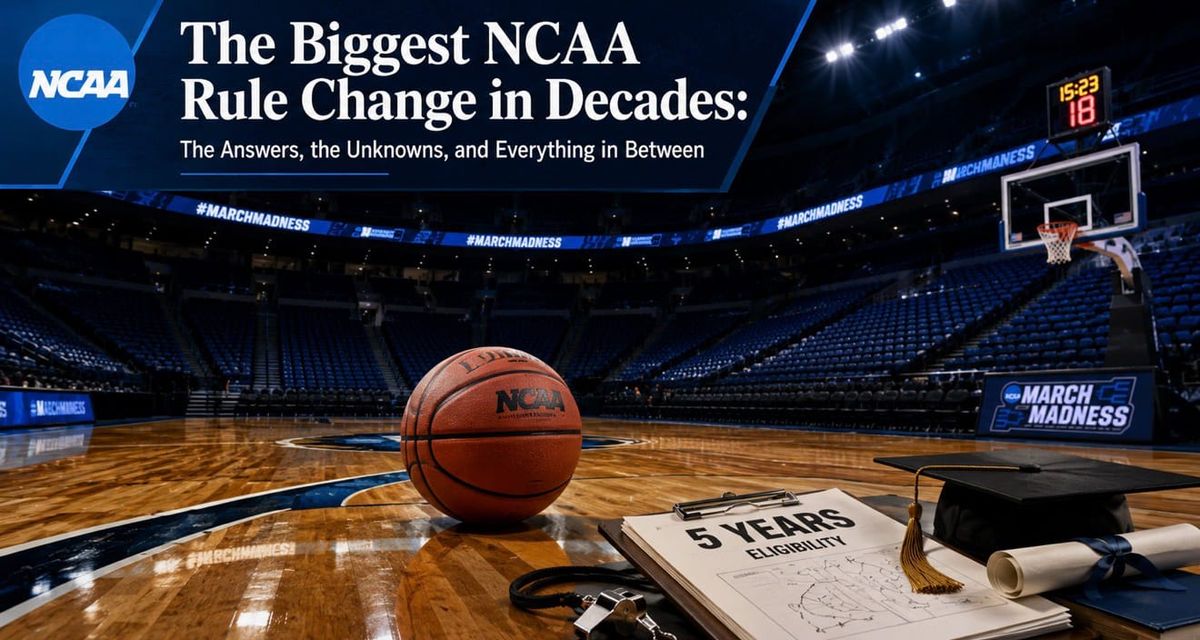
In a sweeping eligibility overhaul, Division I approved what is already being called a “five-for-five” model: five years of eligibility, to be used within a five-year window, with the clock tied to college enrollment and age rather than the old architecture of redshirts, seasons of competition and case-by-case waiver practice. In plain English, the new rule says college athletes get five years — not four seasons stretched by exceptions, not six or seven years built out of petitions, injuries and litigation risk — but five.
The NCAA’s own announcement described the change as a major simplification of the Division I rule book. The rule permits Division I student-athletes up to five years of eligibility if they enroll in college no later than the academic year after their 19th birthday. It eliminates season-of-competition limits, sport-specific eligibility rules, redshirt rules and eligibility-extension waivers.
That is the legal architecture. The cultural message is simpler.
College sports is trying to put the college back in college sports.
The End of the Redshirt World
For decades, the redshirt was one of the quiet operating assumptions of college athletics. A player could arrive on campus, practice, develop physically and academically, and preserve a year of competition. In football, it became part development tool, part roster-management device, part insurance policy. In other sports, medical hardship waivers and delayed-enrollment rules performed similar work.
The old model was built around a familiar bargain: four seasons of competition inside a five-year eligibility clock. That framework could seem simple from the outside, but inside athletic departments it became a dense field of exceptions. Was the injury serious enough? How many games had the athlete played? Did competition occur before enrollment? Did an international athlete’s prior experience count? Did a pandemic year extend the clock? Did a court order, settlement or state law change the analysis?
The new model tries to replace that maze with a rule that a parent, coach, administrator and athlete can understand without calling a compliance lawyer.
The NCAA had previewed the concept earlier this month, saying the eligibility clock would begin upon initial full-time college enrollment or at the beginning of the academic year following the athlete’s 19th birthday, whichever occurs earlier. The final announcement approved Tuesday kept the same basic thrust: a single age-based standard for Division I, fully implemented for athletes initially enrolling full time in fall 2027 or later.
For athletes entering in fall 2026, and for current student-athletes who still have eligibility after the 2025-26 academic year, schools will apply either the old rule or the new age-based model — whichever gives the athlete the better outcome. But athletes who already used their final season of competition during 2025-26 do not get a new year back.
That transition rule will matter. It will almost certainly be litigated.
The NCAA has drawn a line between athletes still inside the system and those whose eligibility has already expired. In the modern college-sports environment, any line that denies a player another year of competition may also deny that player scholarship money, transfer value, roster leverage and NIL opportunity. Eligibility is no longer just a playing-status question. It is an economic asset.
Sign up free for more independent reporting, morning briefings, and long-form storytelling from Short Stop Media — covering law, markets, New York, sports, public affairs, and the stories worth telling.
Why the NCAA Did It
The NCAA’s stated reasoning is twofold: simplicity and alignment.
Josh Whitman, the Illinois athletic director and chair of the Division I Cabinet, said the new rules would be “simpler to administer and easier to predict” for schools and coaches. NCAA President Charlie Baker framed the move as a response to a system that had become too hard to administer in the current legal climate. He also tied the rule to the NCAA’s long-running educational argument, noting that “98% of the 550,000 NCAA student-athletes will go pro in something other than sports.”
That sentence is doing a lot of work.
There is also a harder truth beneath the NCAA’s education language. The 98-percent argument is real: most college athletes will never play professionally, and many do use sports as a bridge to a degree. But the dirty secret — which is no secret at all — is that college sports is also an enormous commercial machine. The NCAA says most of its annual revenue comes from television and marketing rights for the Division I men’s basketball tournament and championship ticket sales, with roughly 60 percent of annual revenue — about $600 million — distributed to Division I schools and conferences, and more than $150 million used to fund Division I championships. In 2025, Football Bowl Subdivision schools reported nearly $12.85 billion in operating revenue. The SEC alone reported about $3.38 billion; the Big Ten, about $3.14 billion. Ohio State reported $336.1 million in athletic department revenue for fiscal year 2025, including $81.7 million in ticket sales and $64.9 million in media rights fees; football alone accounted for about $160.6 million in sport-specific revenue, with men’s basketball adding another $23.5 million. Texas football, meanwhile, generated the most football revenue in the country in 2025 and produced a margin over expenses of nearly $107 million. So when the NCAA speaks about education, it is not wrong. It is just not the whole story. This is a classroom system wrapped inside a multibillion-dollar entertainment economy.
For years, the NCAA has told the public that college sports is not, for almost all participants, a direct path to professional sports. The number is familiar: fewer than 2 percent of NCAA athletes will play professionally in their sport. The vast majority will use athletics as part of an education, not as the first stage of a professional sports career.
But modern college sports has made that argument harder to sustain in the same old way. College football and basketball now operate inside a revenue ecosystem that looks increasingly professional: NIL collectives, transfer bidding, booster-backed compensation, revenue sharing, agents, contract-like commitments and multimillion-dollar roster construction.
The NCAA is therefore trying to hold two truths at once.
First, college athletes deserve greater rights, benefits and compensation than they historically received.
Second, college sports cannot become an indefinite, semi-professional holding pattern where athletes remain on campus deep into their 20s because the rule book, courts and marketplace all point in different directions.
The new eligibility rule is an attempt to restore a calendar.
NIL Changed the Value of Time
To understand why eligibility reform matters now, it is necessary to understand what NIL has done to the value of another year.
Before NIL, an extra season could mean another chance to play, another year of school, another shot at professional attention, or another season recovering from injury. Those things still matter. But now another season can also mean another year of compensation.
For a star quarterback, a high-profile basketball player, a starting offensive lineman, a women’s basketball standout, a lacrosse star, a gymnast, a wrestler, or even a local favorite in a passionate college town, one more season can be worth real money. Sometimes it may be worth more than a marginal professional opportunity. Sometimes it may be the most financially rational choice.
That is the logic driving much of the chaos.
College sports has been trying to absorb several revolutions at once. The House v. NCAA settlement reshaped the financial framework by addressing claims that athletes had been denied the opportunity to earn money from endorsements and media appearances. The settlement created a multibillion-dollar damages structure and changed the future rules to allow additional benefits, including NIL-related benefits, beyond traditional scholarships.
At the same time, states have passed their own NIL laws. Courts have continued to scrutinize NCAA limits. Athletes have challenged eligibility rules. Schools and collectives have looked for ways to recruit and retain players through compensation. Congress has held hearings and introduced competing bills. The transfer portal has become a marketplace. The old amateur model is gone, but no stable replacement has fully taken its place.
In April, the White House described the situation as an “out-of-control financial arms race” driven by football, basketball, eligibility, transfers and pay-for-play arrangements. That is political language, but it captured a reality that even many critics of NCAA power acknowledge: nobody is fully in charge of college sports anymore.
The NCAA’s new five-year model is one attempt to reclaim control over at least one variable: time.
What the Rule Actually Does
The new model does not merely give everyone a fifth season. That would be too simple, and it would miss the larger point.
Instead, the NCAA is changing the way eligibility is measured. The new system ties eligibility to a defined period rather than to a collection of seasons, exceptions and waiver decisions. For most athletes who enroll right after high school, the result may be straightforward: five years to compete for five seasons.
But for athletes who delay enrollment, arrive older, play organized competition elsewhere, or try to extend eligibility through old waiver categories, the new model is far less forgiving.
The NCAA says the rule will be fully effective for prospects who initially enroll full time in fall 2027 or later. Current athletes with eligibility remaining after 2025-26, and those enrolling for the first time in 2026-27, get the more favorable of the old or new rule. Those who used their final season in 2025-26 do not get additional eligibility.
The exceptions are narrow. The NCAA identified pregnancy, active-duty military service and official religious missions as circumstances that may pause or delay the eligibility period, and only if the athlete does not participate in organized competition during the exception.
Just as important is what disappears.
Under the age-based model, the NCAA says waivers will not be available, including clock extensions and waivers previously granted for hardships, seasons of competition and delayed enrollment. For current student-athletes with eligibility remaining under the prior rules, schools must submit waiver requests based on pre-2026 circumstances by July 31, 2026. After that, the waiver door closes.
That is the quiet revolution in the rule.
The NCAA is not just changing the clock. It is trying to end the appeal.
If you enjoyed this article, please consider supporting our work and making a simple one-time donation by clicking below and by subscribing as a Member to our site.
Congress Is Moving on the Same Field
The NCAA’s rule change also lands in the middle of a federal fight over the future of college athletics.
The most important current vehicle is the Protect College Sports Act of 2026, introduced by Senators Ted Cruz, Maria Cantwell, Eric Schmitt and Chris Coons. The bill passed the Senate Commerce Committee on June 18 by a 19-9 vote and now moves to the full Senate. Its supporters say it would stabilize college sports, codify NIL rights, protect scholarships and health care, regulate agents, and preserve women’s and Olympic sports.
The bill’s eligibility language is even more explicit than the NCAA’s announcement. Section 113 provides that a student-athlete may compete for a “maximum of 5 calendar years” beginning at the start of the regular academic year immediately following the earliest of several triggering events, including the athlete’s 19th birthday, actual high school graduation date, expected high school graduation date, or first full-time enrollment at an institution.
That matters because Congress is not merely watching the NCAA. Congress may soon attempt to federalize the same basic idea.
The Senate bill would also reach NIL deals. It would require certain NIL arrangements to have a “valid business purpose” and be commensurate with compensation paid to similarly situated non-athletes. It would also provide antitrust protections for enforcing rules around eligibility, transfers, compensation and related areas.
That antitrust protection is the prize the NCAA and major conferences have been seeking for years. Without it, every new rule risks becoming the next lawsuit.
In fact, the antitrust issue is the quiet legal engine behind all of this. For a casual reader, antitrust law simply means the body of law that protects competition — the rules that stop competitors from joining together to fix prices, divide markets or artificially limit what workers, sellers or consumers can get in an open market. In college sports, the NCAA’s problem is that its members are not one school; they are hundreds of competing schools acting together. When those schools collectively agree on eligibility limits, transfer limits, NIL rules, compensation caps or roster rules, athletes can argue that the schools are restraining the market for their athletic services. That is why the NCAA wants Congress to give it targeted antitrust protection. Without it, every new national rule risks becoming the next lawsuit. With it, the NCAA could enforce a five-year clock, NIL limits and compensation rules with far less fear that a court will later say the schools illegally joined together to suppress athlete opportunity.
But passage is far from assured.
The Protect College Sports Act is now the most viable federal vehicle because it has bipartisan sponsorship and has already cleared committee. But it still needs 60 votes in the Senate, and it would then need a path through a House where the earlier SCORE Act collapsed.
The SCORE Act — formally the Student Compensation and Opportunity through Rights and Endorsements Act — had been the leading House proposal. It would have created a national framework for NIL and given college sports governing bodies legal protection to enforce rules. But it stalled after House leaders pulled it from consideration amid lack of support and sharp opposition, including from the Congressional Black Caucus. In its current form, SCORE appears unlikely to survive. Its ideas, however, may live on inside other legislation.
Other proposals remain part of the broader conversation, including athlete-protection bills, media-rights proposals, and efforts to clarify whether college athletes can be treated as employees. But the central legislative question is now whether Congress can pass a national framework before another wave of litigation and state-law conflict makes the current model unmanageable.
The odds are better than they were a month ago. They are still not high enough for anyone in college sports to plan with confidence.
The Coming Lawsuits
The new NCAA rule is designed to reduce litigation. It may first create more of it.
Any transition rule creates winners and losers. An athlete with eligibility remaining may benefit. An athlete whose final season ended this spring may be excluded. A 2026 enrollee may get a choice between old and new rules. A 2027 enrollee may not. An older international athlete may see the rule as a hard barrier. An athlete who lost time to injury may argue that the NCAA has replaced one unfair system with another.
The NCAA will argue that the new rule is uniform, transparent and administrable. Opponents will argue that it restricts opportunity and does so in a market where eligibility carries real economic value.
That is the paradox of the NIL era. The more the NCAA insists that college sports is educational, the more the marketplace treats eligibility as compensation-adjacent. The more schools pay or facilitate benefits, the harder it becomes to describe another season as merely another chance to participate.
This is where the 2 percent argument cuts both ways.
If 98 percent of athletes will go pro in something other than sports, then college sports should be organized around education, degree completion and a normal college timeline. That is the NCAA’s argument. But if athletes are generating revenue, entering NIL agreements, transferring through competitive markets and receiving direct benefits, then the difference between college and professional sports becomes harder to police through rhetoric alone.
The five-for-five rule is the NCAA’s answer: compensate more, litigate less, simplify the rule book, and keep the eligibility window tied to the life cycle of college.
Whether courts will accept that answer remains to be seen.
Sign up free for more independent reporting, morning briefings, and long-form storytelling from Short Stop Media — covering law, markets, New York, sports, public affairs, and the stories worth telling.
Who Wins and Who Loses
For athletes who enroll on time and stay healthy, the rule may be a benefit. A player who once would have had four seasons inside five years may now have the possibility of five seasons in five years. Coaches may use more freshmen without worrying about burning a redshirt. Roster planning may become cleaner. Families may understand the clock more easily.
For athletes who develop late, suffer repeated injuries, start college older, change sports, serve unusual paths, or rely on waivers, the rule may feel harsh.
That is why the new bright-line rule needs a human footnote. Not every crooked path through college sports is a loophole. Sometimes it is simply life. As all New Yorkers, and hardcore NBA fans know, John Starks was not a polished one-and-done prospect or a teenage certainty. He played only one year of high school basketball, bounced through multiple Oklahoma colleges, worked at a Safeway supermarket, found his way back through junior-college basketball, earned a scholarship to Oklahoma State, went undrafted, and eventually became an All-Star guard and folk hero for the New York's beloved Knicks. His story does not prove that every older athlete belongs in college sports forever. But it does prove something important: talent does not always arrive on schedule. A rule designed to end abuse can still catch real people in the gears — late bloomers, poor kids, transfers, international athletes, injured players, military families, and young men and women whose lives do not move in the neat four-year increments imagined by a compliance manual.
For high school recruits, the rule could reshape recruiting calendars and roster math. A fifth year for more athletes means fewer openings for incoming players unless roster limits and scholarship structures adjust. For coaches, the rule removes one type of uncertainty but creates another: every roster may now have more athletes expecting to play for five full years.
For non-revenue sports, the consequences may be even more complicated. A fifth year could help athletes complete degrees, recover from injury and mature competitively. But if roster spots are capped and athletic departments are squeezed by revenue-sharing obligations, older athletes staying longer may limit opportunities for younger athletes arriving behind them.
That is the hidden tension inside almost every modern college-sports reform. A rule that expands rights for current athletes can narrow access for future ones.
A Reset, Not a Finish Line
The NCAA’s adoption of the five-for-five model is not the end of the college-sports revolution. It is a reset of one major piece.
The NIL market remains unsettled. Revenue sharing remains contested. The employment-status question remains alive. Congress may act, but may also stall. State laws may conflict. Athletes will sue. Schools will adapt. Conferences will keep searching for leverage. The biggest football and basketball programs will continue to behave like billion-dollar entertainment properties housed inside universities.
But the NCAA has now made one thing clear: the endless eligibility era is coming to an end.
The old rule book treated time like something that could be stretched — by injury, by waiver, by exception, by redshirt, by litigation, by pandemic, by creative compliance. The new rule treats time like a boundary.
Five years.
Five seasons.
Five for five.
In the middle of college sports’ most chaotic financial age, the NCAA has reached back for an old idea: college should have a beginning, a middle and an end.
The question now is whether the courts, Congress, schools, athletes and the NIL marketplace will let that idea survive.
If you enjoyed this article, please consider supporting our work and making a simple one-time donation by clicking below and by subscribing as a Member to our site.

Comments ()